

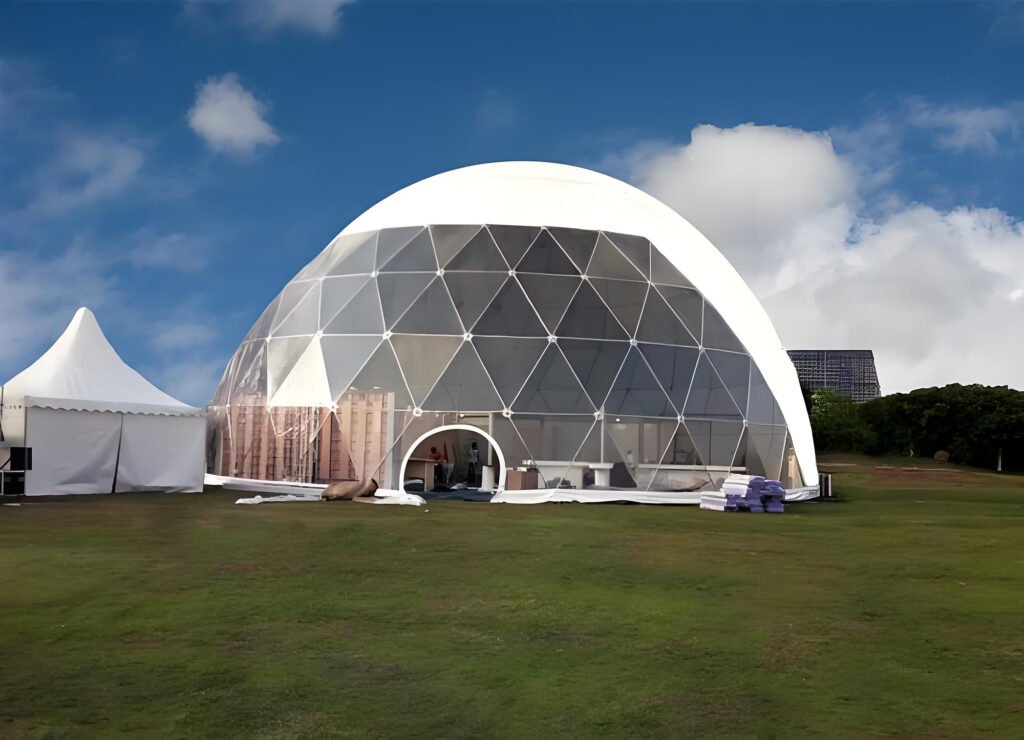
L'un des aspects les plus attrayants d'un moderne tente dôme sa zone de vision transparente.
Utilisé pour :
- glamping de luxe
- Événements en plein air
- Activations de la marque
- Restaurants
- Salons d'hiver
- Espaces d'exposition
La fenêtre panoramique transparente crée une expérience immersive que les tentes standard ne peuvent égaler.
Cependant, de nombreux propriétaires de tentes dôme rencontrent un problème inattendu après seulement une saison d'utilisation :
Le panneau transparent, autrefois limpide comme du cristal, commence à ressembler à :
- Brumeux
- Brumeux
- Laiteux
- Rayé
- Recouvert de minuscules fissures en forme de toile d'araignée
Certains clients supposent même que le matériau est défectueux.
D'autres se demandent :
“ La fenêtre de ma tente dôme se détériore-t-elle à cause de l'exposition aux UV ? ”
“ Le fabricant a-t-il utilisé du PVC bon marché ? ”
“ Ces fissures peuvent-elles se propager et finir par provoquer une rupture ? ”
“ Comment puis-je éviter que cela ne se reproduise lors de mon prochain achat de tente dôme ? ”
En tant que professionnel fabricant de tentes dôme Avec plus de 10 ans d'expérience dans la conception et la fabrication de tentes événementielles commerciales, de dômes géodésiques, de dômes de glamping et de structures sur mesure, Dtent aide fréquemment ses clients à diagnostiquer ce que les ingénieurs appellent :
Folie
Le craquelage est l'un des mécanismes de défaillance les plus mal compris des matériaux de dômes transparents.
La bonne nouvelle :
Dans de nombreux cas, cela peut être évité.
La bonne nouvelle :
Comprendre les véritables causes permet aux acheteurs de choisir une tente dôme de meilleure qualité et d'en prolonger considérablement la durée de vie.
Qu’est-ce que la " folie " dans une tente dôme ?
Le terme « fendillement » désigne la formation de fissures microscopiques au sein de matériaux plastiques transparents.
Contrairement à une fracture visible, la fissuration commence souvent par :
- Fines lignes blanches
- Zones nuageuses
- Zones brumeuses
- Motifs de toile d'araignée
Au départ, le matériau peut encore paraître structurellement intact.
Cependant, à fort grossissement, on peut souvent observer des milliers de minuscules fissures.
Ces fissures diffusent la lumière.
C’est pourquoi la partie transparente commence à ressembler à :
- Brumeux
- Givré
- Laiteux
Même si la surface peut encore paraître lisse.
Pourquoi les panneaux transparents des tentes en forme de dôme sont-ils vulnérables ?
Contrairement aux revêtements en tissu, les parties transparentes utilisent généralement des matériaux plastiques tels que :
PVC transparent
Courant dans les dômes événementiels.
TPU
De plus en plus utilisé dans les constructions haut de gamme.
Polycarbonate
Applications architecturales haut de gamme.
Acrylique
Utilisé occasionnellement dans les systèmes à dôme rigide.
Chaque matériau présente des avantages uniques.
Cependant, tous les polymères transparents sont confrontés au même défi :
Vieillissement environnemental
L'exposition en extérieur est extrêmement exigeante.
Le matériau doit résister à :
- rayonnement UV
- Chaleur
- Froid
- Vent
- Humidité
- Dilatation et contraction
- contrainte mécanique
Avec le temps, ces facteurs s'accumulent.
Finalement, la folie s'installe.


La défaillance du stabilisateur UV est-elle la cause principale ?
En bref :
Parfois
Mais pas toujours.
De nombreux acheteurs pensent que l'exposition aux UV est la seule responsable.
La réalité est plus complexe.
La dégradation par les UV n'est souvent qu'un facteur parmi d'autres.
En analyse de défaillance professionnelle, la fissuration résulte généralement d'une combinaison de facteurs :
- vieillissement aux UV
- contrainte mécanique
- exposition chimique
- Qualité des matériaux
- conditions d'installation
Examinons chaque facteur.
Cause #1 : Décomposition due au rayonnement UV
L'exposition aux UV est la cause la plus fréquente de la détérioration des dômes transparents.
La lumière du soleil contient de l'énergie ultraviolette capable de rompre les liaisons moléculaires des plastiques.
Au fil du temps:
La structure polymère s'affaiblit.
Les conséquences incluent :
- Flexibilité réduite
- Oxydation de surface
- Décoloration
- Fragilisation
- Microfissuration
Lorsque la flexibilité diminue, de minuscules fissures de tension commencent à se former.
C'est le début de la folie.
Pourquoi les fenêtres des tentes dôme bon marché se détériorent-elles plus rapidement ?
Tous les matériaux transparents n'offrent pas la même protection contre les UV.
Les fournisseurs à bas prix réduisent souvent leurs coûts en utilisant :
- PVC de qualité inférieure
- Additifs UV minimaux
- Teneur en résine recyclée
Au premier abord, ces matériaux peuvent sembler identiques aux alternatives haut de gamme.
Après six à douze mois passés en extérieur, les différences deviennent évidentes.
Un emballage UV de haute qualité peut doubler ou tripler la durée de vie.
C’est l’une des raisons pour lesquelles les acheteurs expérimentés évaluent l’ensemble des spécifications plutôt que de simplement comparer les prix.
Cause #2 : Dilatation et contraction thermiques
L'une des causes les plus négligées de tente dôme Le craquelage est dû à des cycles de température.
Les panneaux transparents subissent d'importantes variations de température.
Par exemple:
Midi d'été
Température de surface :
140°F–180°F (60°C–82°C)
Nuit
Température de surface :
50°F–70°F (10°C–21°C)
Cette dilatation et cette contraction quotidiennes créent du stress.
Sur plusieurs mois :
Une fatigue microscopique se développe.
Finalement:
Des microfissures apparaissent.
Pourquoi la géométrie des tentes en dôme augmente-t-elle le stress ?
A tente dôme n'est pas une structure plate.
La fenêtre transparente est soumise en permanence à :
- Courbure
- Tension
- Charge du vent
Contrairement au verre architectural, les matériaux de fenêtres flexibles sont en mouvement constant.
Chaque rafale de vent engendre des cycles de stress.
Ces charges répétitives accélèrent la fissuration.
Cause #3 : Tension excessive du tissu
De nombreux installateurs créent sans le savoir des conditions qui favorisent la fissuration.
Une erreur fréquente consiste à trop tendre le panneau transparent.
Le raisonnement semble logique :
Un tissu plus serré est plus esthétique.
Cependant:
Une tension excessive crée des contraintes permanentes au sein du matériau.
Lorsqu'il est combiné avec :
- exposition aux UV
- fluctuations de température
- charges dues au vent
Les microfissures se développent beaucoup plus rapidement.
Professionnel fabricants de tentes dôme Spécifiez soigneusement les niveaux de tension admissibles.
Cause #4 : Dommages chimiques
Il s'agit là d'une des causes de fissuration les moins bien comprises.
De nombreux produits de nettoyage contiennent des substances chimiques qui attaquent les polymères transparents.
Les coupables les plus fréquents sont :
Nettoyants à base d'ammoniaque
On les trouve souvent dans les produits nettoyants pour vitres ménagers.
Solvants
Peut fragiliser les structures en plastique.
Produits à base d'alcool
Une utilisation répétée peut accélérer le vieillissement.
Dégraissants agressifs
Peut enlever les traitements de surface protecteurs.
Les dégâts peuvent ne pas être immédiatement visibles.
Quelques semaines plus tard :
De fines fissures commencent à apparaître.
Pourquoi un nettoyage inadéquat provoque la formation de buée
Beaucoup tente dôme Les propriétaires frottent vigoureusement les vitres transparentes.
Cela crée :
- Abrasion de surface
- Micro-rayures
- Clarté réduite
Ces minuscules rayures diffusent la lumière.
Le résultat :
Un aspect trouble souvent confondu avec des dommages causés par les UV.
Cause #5 : Formulations plastiques de qualité inférieure
Deux feuilles de PVC transparentes peuvent sembler identiques.
Pourtant, leurs performances peuvent varier considérablement.
Les principaux facteurs de qualité comprennent :
Teneur en stabilisateur UV
Qualité du plastifiant
Pureté de la résine
Cohérence de la fabrication
Technologie de revêtement
Les matériaux bon marché contiennent souvent :
- Plus de produits de comblement
- Protection UV réduite
- Additifs de qualité inférieure
Ces facteurs augmentent le risque de fissuration.
PVC ou TPU : lequel est le plus performant ?
De nombreuses offres premium fabricants de tentes dôme de plus en plus de fenêtres en TPU sont adoptées.
Comparons.
PVC
Avantages :
- coût inférieur
- Fabrication facile
- Bonne transparence
Inconvénients :
- Plus susceptible au jaunissement
- flexibilité à long terme réduite
TPU
Avantages :
- Meilleure élasticité
- résistance supérieure aux UV
- Résistance améliorée aux fissures
Inconvénients :
- coût plus élevé
Pour les installations de longue durée, le TPU offre souvent une meilleure durabilité.
Pourquoi la buée se forme-t-elle avant l'apparition des fissures ?
De nombreux clients remarquent d'abord la formation de buée.
C'est un signe avant-coureur important.
Le processus se déroule généralement comme suit :
Étape 1
Perte de brillance de surface.
Étape 2
Aspect brumeux.
Étape 3
Des microfissures se développent.
Étape 4
Fissures capillaires visibles.
Étape 5
Affaiblissement structurel.
Identifier les problèmes au plus tôt peut éviter des remplacements coûteux.
Comment inspecter votre tente dôme pour détecter les premières craquelures
Effectuer des inspections périodiques.
Cherchez :
Zones nuageuses
Surtout autour des points de fixation.
Fines lignes blanches
Souvent visible en plein soleil.
Transparence réduite
Comparez avec les nouvelles sections si possible.
Rugosité de surface
Peut indiquer une dégradation du matériau.
Le dépistage précoce permet une action préventive.
Les fenêtres fissurées des tentes dôme sont-elles réparables ?
Malheureusement:
Pas complètement.
Une fois que des craquelures se forment à l'intérieur de la structure polymère, la restauration est difficile.
Un léger voile de surface peut être amélioré par polissage.
Cependant:
Les fissures internes ne peuvent généralement pas être éliminées.
Le remplacement est souvent la solution la plus sûre.
Comment prévenir le craquellement des tentes dôme
Choisissez des matériaux stabilisés aux UV
Demander les spécifications documentées de protection UV.
Il ne s'agit pas d'allégations marketing.
Évitez la surtension
Suivez les instructions du fabricant.
Une tension excessive accélère la fatigue.
Utilisez des produits de nettoyage appropriés
Utiliser:
- Savon doux
- Chiffons en microfibre douce
- Nettoyants non abrasifs
Évitez les produits chimiques agressifs.
Réduire l'exposition continue aux UV
Si possible :
- Utilisez des structures d'ombrage
- Appliquer des housses de protection pendant le stockage
Choisir des matériaux de fenêtres haut de gamme
Pour les applications commerciales :
Le TPU est souvent plus performant que le PVC standard.
Questions à poser à un fabricant de tentes dôme
Avant d'acheter, demandez :
De quel matériau sont utilisés les panneaux transparents ?
Le matériau est-il stabilisé aux UV ?
Quelle est la durée de vie prévue en extérieur ?
Le matériau de la fenêtre a-t-il subi des tests de vieillissement accéléré ?
Le TPU est-il disponible en option de mise à niveau ?
Quelle garantie s'applique aux composants transparents ?
Une personne réputée usine de tentes dôme devrait répondre clairement à ces questions.
Comment Dtent aborde la question de la durabilité des fenêtres des tentes dôme
En tant que personne expérimentée fabricant de tentes dôme, Dtent comprend que les sections transparentes constituent souvent la partie la plus importante de la structure sur le plan visuel.
Notre approche d'ingénierie est axée sur :
Sélection de matériaux haut de gamme
Nous évaluons soigneusement :
- Résistance aux UV
- clarté optique
- flexibilité à long terme
Tension contrôlée du tissu
Une conception appropriée réduit les contraintes inutiles sur les composants transparents.
Fabrication de qualité commerciale
Nous privilégions la durabilité aux économies de coûts à court terme.
Solutions personnalisées
En fonction des exigences du projet, nous pouvons recommander :
- systèmes de fenêtres en PVC
- Matériaux résistants aux UV améliorés
- panneaux transparents en TPU
- Solutions d'installation à long terme
L'avenir de la technologie des tentes dômes transparentes
L'industrie s'oriente vers des matériaux avancés qui offrent :
Résistance aux UV améliorée
Surfaces autonettoyantes
Clarté optique améliorée
Une meilleure flexibilité
Durée de vie prolongée
Ces innovations permettent aux tentes dôme modernes d'avoir une durée de vie nettement supérieure à celle des générations précédentes.
Pourquoi les fenêtres des tentes dôme s'embuent-elles et présentent-elles des microfissures ?
Le problème de “ fissuration ” est rarement causé par un seul facteur.
Il résulte généralement de l'interaction de :
- exposition aux UV
- Chaleur
- contrainte mécanique
- Nettoyage inadéquat
- Qualité des matériaux
- pratiques d'installation
Bien qu'une défaillance du stabilisateur UV puisse contribuer au problème, elle n'en représente souvent qu'une partie.
La meilleure stratégie de prévention consiste à choisir une qualité élevée tente dôme d'une personne expérimentée fabricant de tentes dôme, privilégiez les matériaux stabilisés aux UV, évitez les tensions excessives et suivez les procédures d'entretien appropriées.
Lors de l'évaluation d'un usine de tentes dôme, Ne vous focalisez pas uniquement sur les spécifications de la structure ou le poids du tissu. La qualité de la partie transparente du dôme détermine souvent l'aspect de la structure après une, trois ou cinq années d'utilisation en extérieur. Un dôme parfaitement transparent aujourd'hui doit le rester dans plusieurs années ; cela repose sur le choix des matériaux et la qualité de sa conception.
Vous êtes une société commerciale ou un fabricant ?
Nous sommes un fabricant spécialisé dans les tentes pliantes, les parapluies d'extérieur, les drapeaux de plage et les bannières publicitaires.
Pouvez-vous réaliser un design à partir de mes idées ou de mes dessins ?
Oui, nous avons des concepteurs expérimentés et notre propre usine de moulage. En fonction de vos besoins, nous pouvons concevoir ou ouvrir des moules à des prix compétitifs.
Combien de temps dure l'échantillonnage ?
Les échantillons seront prêts dans un délai de 5 à 7 jours, en fonction de vos exigences en matière d'impression et de matériaux.
Quel est votre avantage ?
Efficacité des coûts ; prix bas ; Efficacité des délais : nous nous engageons à effectuer les livraisons de masse dans les 30 jours Efficacité des services : nos vendeurs s'engagent à répondre à votre demande dans les 12 heures : Nos vendeurs s'engagent à répondre à votre demande dans les 12 heures. whatsapp 86 180 3827 3926