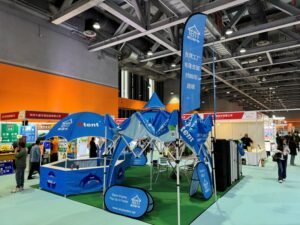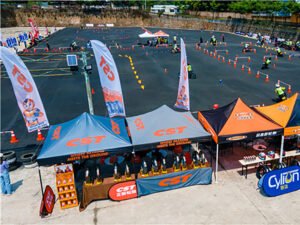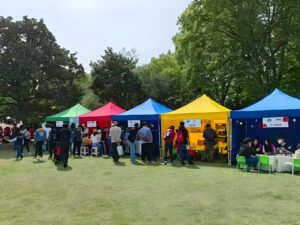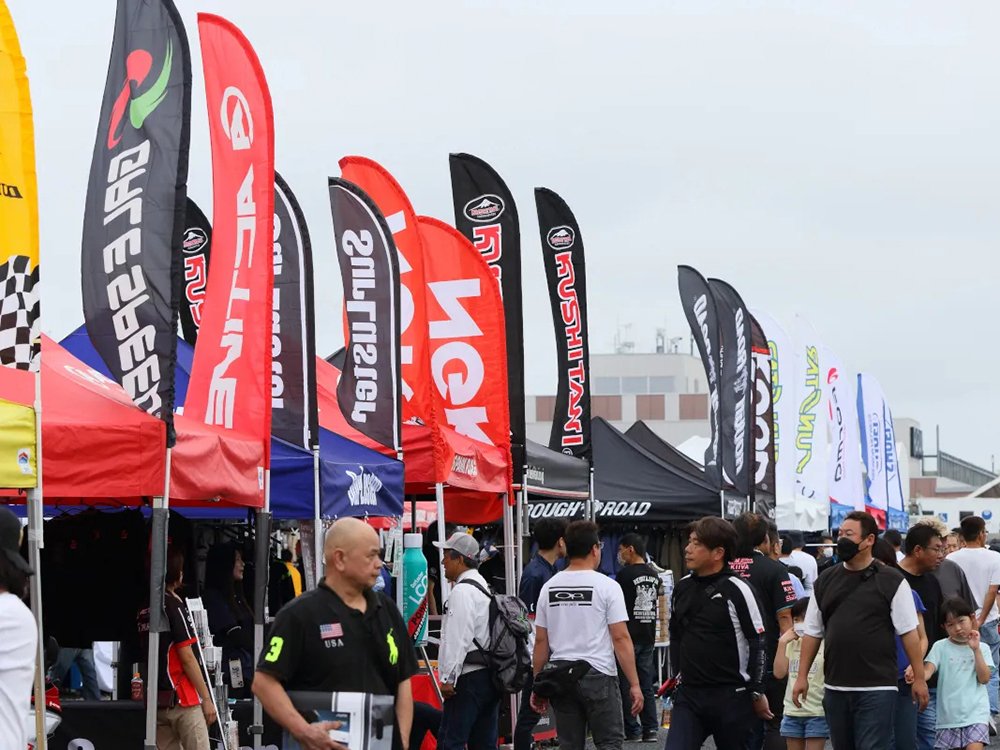

When brands participate in trade shows, exhibitions, outdoor promotions, sporting events, product launches, or corporate marketing campaigns, an tente d'exposition is more than a temporary shelter. It is a mobile brand display system that combines protection, visual communication, structural stability, and customer experience.
For brands that need customized graphics, logos, colors, dimensions, and accessories, choosing the right exhibition tent factory is therefore much more important than simply comparing product prices.
Un professionnel exhibition tent factory should be able to translate a customer’s branding concept into a manufacturable tent structure, select appropriate materials, control printing quality, manufacture reliable frames, perform accurate sewing and assembly, and maintain consistent quality across repeated orders.
Dtent is a professional custom tent manufacturer with more than 10 years of manufacturing experience and a 6,000㎡ production facility. The company provides customized commercial tents, event tents, exhibition tents, pop-up canopies, and other temporary display structures for brand customers in different markets.
This article explains what buyers should look for in an exhibition tent factory, how a professional factory manages customization, and why Dtent can be a suitable manufacturing partner for brands looking for custom exhibition tent solutions.
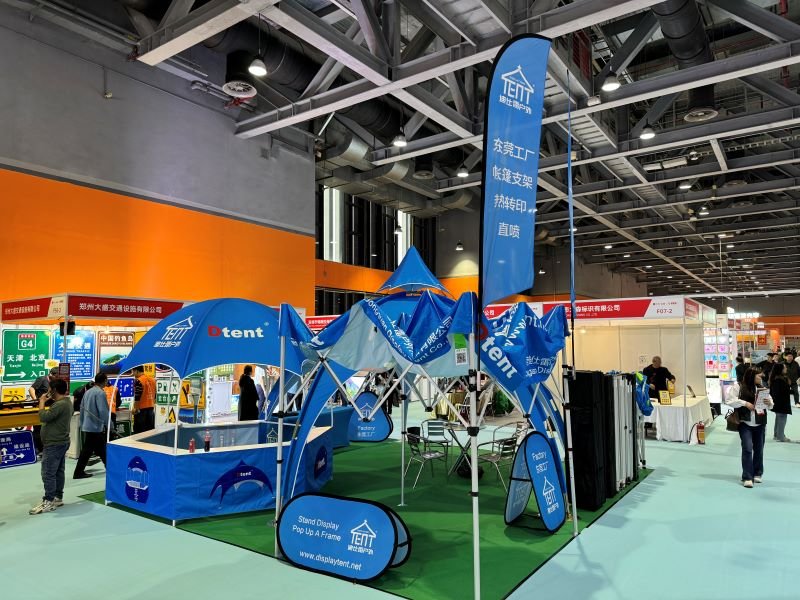
1. What Is an Exhibition Tent Factory?
Un exhibition tent factory is a manufacturing facility that designs, produces, assembles, and quality-controls tents specifically intended for exhibitions, trade shows, promotional events, outdoor displays, corporate activities, and other commercial applications.
Unlike a simple tent trading company, a capable exhibition tent factory should control several manufacturing processes.
These processes may include:
- Tent structure engineering
- Aluminum or steel frame production
- Roof and sidewall fabric cutting
- Digital or dye-sublimation printing
- Sewing and reinforcement
- Connector and hardware installation
- Waterproofing treatment
- Graphic alignment
- Accessory manufacturing
- Final assembly
- Inspection de la qualité
- Emballage et expédition
The most important difference is manufacturing control.
When a customer orders a completely customized exhibition tent, many components must work together. The frame dimensions determine the fabric dimensions. Fabric dimensions influence graphic positioning. Printing specifications influence the final visual appearance. Sewing accuracy affects installation. Hardware affects structural stability.
Un professionnel exhibition tent manufacturer must therefore manage the entire system rather than treating the tent as a simple printed fabric product.
2. Why Should Brands Buy Directly from an Exhibition Tent Factory?
For brands purchasing customized exhibition tents, factory-direct cooperation can provide several advantages.
The first is better communication.
When customers communicate directly with an exhibition tent factory, technical information can move directly between the brand and the production team. Instead of passing specifications through multiple distributors, the factory can evaluate dimensions, materials, printing requirements, structural requirements, and packaging requirements directly.
The second advantage is customization flexibility.
A trading company may mainly recommend existing models. A professional exhibition tent factory can modify the product according to the customer’s application.
Customization can include:
- Dimensions de la tente
- Frame material
- Profil de jambe
- Roof design
- Parois latérales
- Parois arrière
- Windows
- Doors
- Zones d'impression
- Fabric weight
- Couleur du tissu
- Emplacement du logo
- Carry bags
- Ground fixing
- Ballast systems
- Lighting accessories
- Display accessories
For brands planning long-term campaigns, direct factory cooperation can also make repeat orders easier because specifications can be retained and reproduced consistently.
3. Exhibition Tent Factory Capability Starts with Application Analysis
A good exhibition tent factory should not immediately quote a product simply because a customer provides a size.
La première question devrait être :
Where and how will the exhibition tent be used?
For example, a tent used inside a trade show hall has different requirements from a tent used at an outdoor automotive event.
A professional factory should evaluate:
- Indoor or outdoor application
- Expected weather conditions
- Taille de la tente
- Number of visitors
- Required branding area
- Transportation method
- Frequency of setup and dismantling
- Expected service life
- Required accessories
- Local event regulations
This application-first approach is particularly important for a custom exhibition tent.
For example, a brand attending frequent international exhibitions may prioritize lightweight construction and transportation efficiency. A company operating outdoor promotional events may prioritize waterproofing, wind resistance, ballast compatibility, and durable printing.
The correct tent is therefore not necessarily the largest or strongest model. It is the model that matches the actual application.
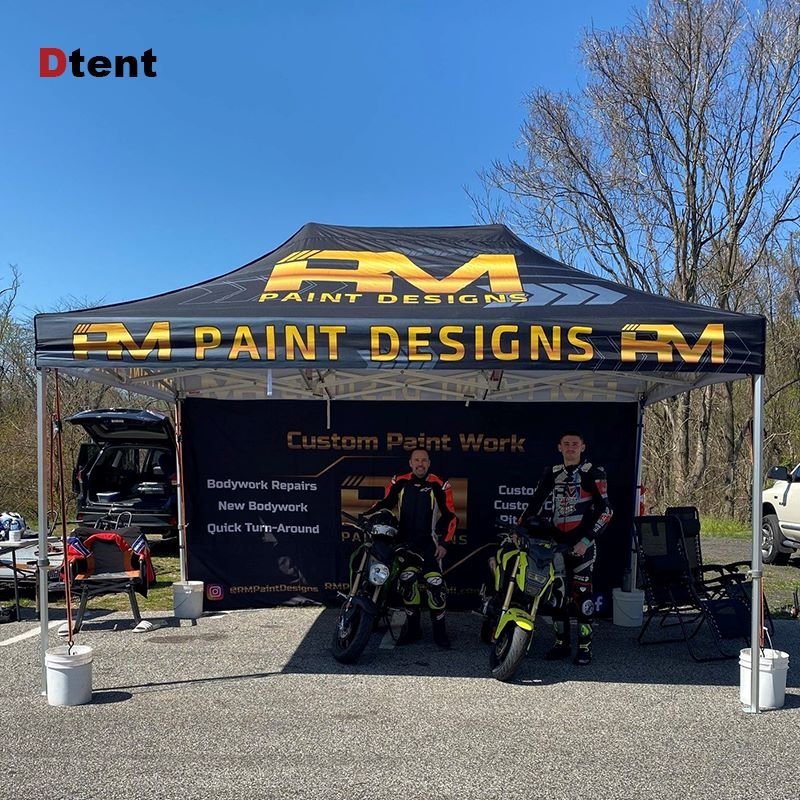
4. 10×10 Exhibition Tent: One of the Most Popular Sizes
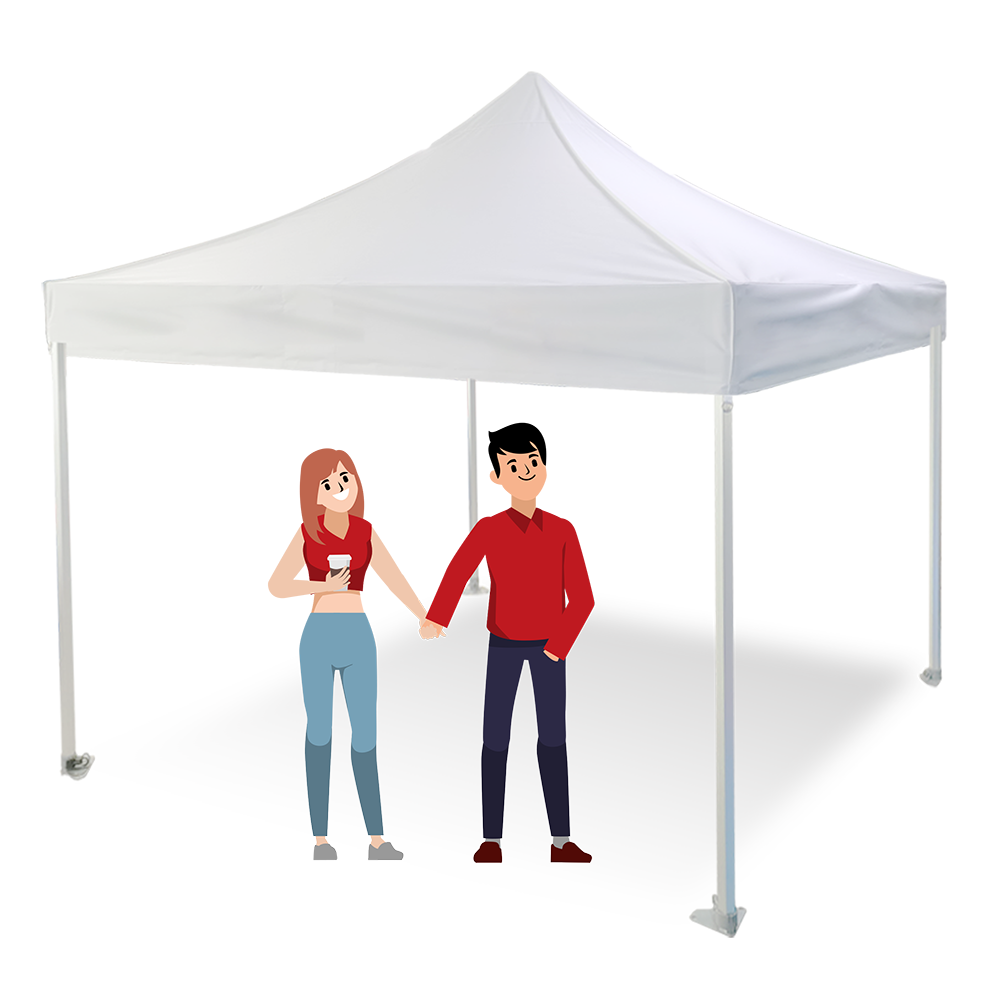
Les 10×10 exhibition tent is one of the most practical configurations for promotional events, trade shows, markets, sports events, and brand activations.
A 10×10 ft footprint provides approximately 100 square feet of covered floor area while remaining relatively easy to transport and install.
A typical 10×10 exhibition tent can be configured with:
- Full printed roof
- Four printed valances
- Flancs pleins
- Half sidewalls
- Mur arrière
- panneaux de porte
- Transparent windows
- Counter displays
- Printed flooring
- Carry bag
- Weight bags
- Ground stakes
The 10×10 exhibition tent is especially attractive for brands because it provides a useful balance between:
Brand visibility + usable space + transportation efficiency + installation convenience.
However, a professional exhibition tent factory should not assume that 10×10 is suitable for every customer.
Other common configurations include:
| Exhibition Tent Size | Typical Application |
|---|---|
| 5×5 ft | Small promotional displays |
| 8×8 ft | Compact exhibitions and sampling |
| 10×10 ft | Trade shows and general promotions |
| 10×15 ft | Des présentoirs de produits plus grands |
| 10×20 ft | Brand activations and commercial events |
| 20×20 ft | Large exhibitions and hospitality |
| Custom sizes | Special exhibition or event layouts |
The factory should recommend dimensions based on the customer’s available space, visitor flow, transportation requirements, and branding objectives.
5. Custom Exhibition Tent Design: From Artwork to Production
One of the most important capabilities of an exhibition tent manufacturer is converting customer artwork into production-ready graphics.
A customer may provide:
- Brand logo
- Corporate colors
- Images du produit
- Advertising graphics
- Slogans
- Website information
- codes QR
- Marketing artwork
However, a graphic file cannot simply be printed onto a tent without technical preparation.
The factory must consider the physical structure of the tent.
For example, a logo positioned close to a seam may become partially hidden. A graphic crossing a corner can become visually distorted. Text placed near a zipper or Velcro area may become difficult to read.
Therefore, professional artwork preparation should consider:
- Positions des coutures
- Corner locations
- Fabric stretch
- Printing bleed
- Sewing allowances
- Frame geometry
- Valance dimensions
- Zipper positions
- Door openings
- Window positions
This is where the experience of an exhibition tent factory becomes particularly valuable.
The objective is not simply to print the customer’s artwork. The objective is to make sure that the finished tent looks like the original brand design after the fabric has been cut, sewn, stretched, and installed.
6. Exhibition Tent Factory Printing Technology Determines Brand Quality
Printing quality has a direct impact on how a brand is perceived.
An exhibition tent may have a technically strong frame, but poor printing can make the entire display look inexpensive.
Depending on the fabric and application, an exhibition tent factory may use different printing technologies, including dye-sublimation or other suitable digital textile printing processes.
For premium brand displays, dye-sublimation printing is often attractive because the ink becomes integrated into the textile fibers, allowing detailed graphics and vibrant visual reproduction.
Important printing factors include:
- Color consistency
- Resolution
- Ink penetration
- Graphic alignment
- Edge-to-edge coverage
- Repeat-order consistency
- Fabric compatibility
- exposition aux UV
- Washing and cleaning resistance
Brand colors can be particularly challenging.
A company may have strict requirements for its corporate colors, and a factory should establish suitable production references rather than relying only on the appearance of a digital monitor.
For repeated campaigns, maintaining color consistency between batches becomes even more important.


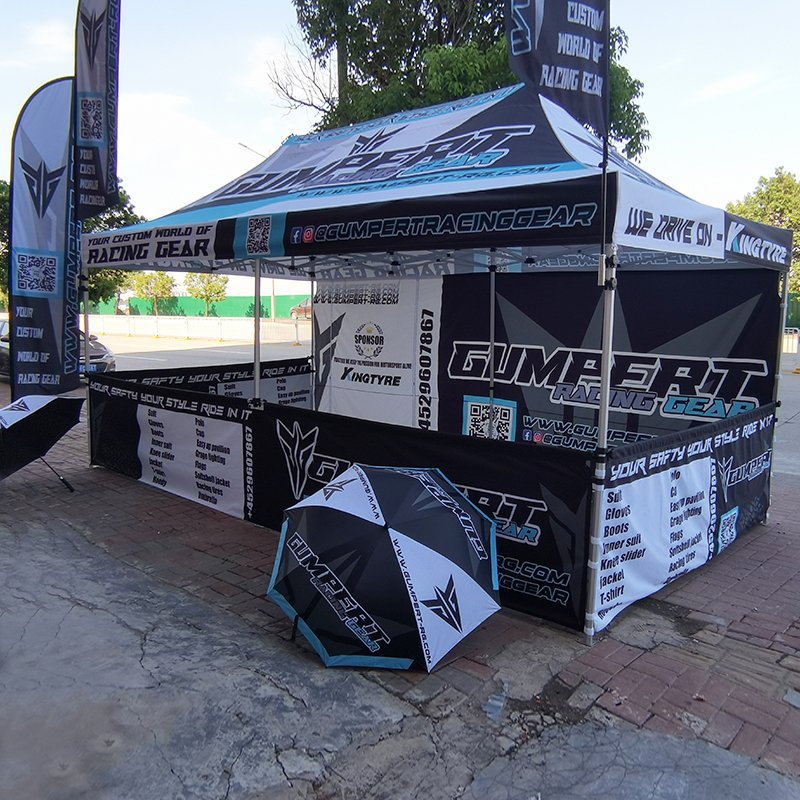
7. Frame Engineering Is a Core Responsibility of an Exhibition Tent Factory
The fabric is highly visible, but the frame is the structural backbone of the exhibition tent.
Un professionnel exhibition tent factory should pay attention to:
- Aluminum profile selection
- Steel component selection
- Dimensions du tube
- Épaisseur de paroi
- Connector strength
- centres de données
- barres de renfort
- Leg sliders
- Mécanismes de verrouillage
- Rivets
- Bolts
- Plaques de base
- Surface treatment
For portable exhibition tents, the frame needs to balance strength and portability.
An oversized frame may increase transportation weight and cost. An undersized frame may reduce durability.
This is why experienced manufacturers evaluate the frame as a complete structural system.
For a frequently assembled custom exhibition tent, the factory should also consider repeated mechanical movement.
A tent may be opened and closed hundreds of times during its service life. Therefore, components such as sliders, hinges, connectors, rivets, and locking systems can be just as important as the main aluminum profile.
8. Fabric Selection: What Should an Exhibition Tent Factory Recommend?
The correct fabric depends on the application.
Un professionnel exhibition tent manufacturer may recommend different textile specifications according to:
- Waterproofing requirements
- exposition aux UV
- Poids
- Qualité d'impression
- Flame-retardant requirements
- Résistance à la déchirure
- Cleaning requirements
- Folding frequency
- Indoor or outdoor use
Common tent fabric considerations include polyester textiles with suitable coatings or treatments.
For indoor exhibitions, appearance and printing quality may be the highest priorities.
For outdoor events, the customer may require stronger emphasis on:
- Water resistance
- Résistance aux UV
- Résistance à la déchirure
- Wind management
- Flame performance
- Cleaning durability
The factory should therefore avoid recommending one fabric specification for every application.
A professional approach is to select the fabric according to the complete operating environment.
9. Sewing and Reinforcement Are Critical for Custom Exhibition Tents
Printing gets attention, but sewing determines how the printed fabric performs as a physical component.
A custom exhibition tent can contain:
- Seams
- Fermetures à glissière
- Velcro
- Webbing
- Reinforced corners
- Points de fixation
- Pole sleeves
- Roof pockets
- Sidewall connectors
These areas experience different mechanical loads.
For example, corners may experience higher tension when the roof is installed. Zipper areas may experience repeated pulling forces. Velcro areas may be opened and closed frequently.
Un professionnel exhibition tent factory should therefore reinforce critical areas rather than treating every fabric section identically.
Good sewing quality should provide:
- Straight seams
- Consistent stitch density
- Strong thread
- Accurate dimensions
- Points de tension renforcés
- Clean finishing
- Proper zipper installation
- Consistent Velcro placement
This is particularly important when a brand orders hundreds or thousands of tents.
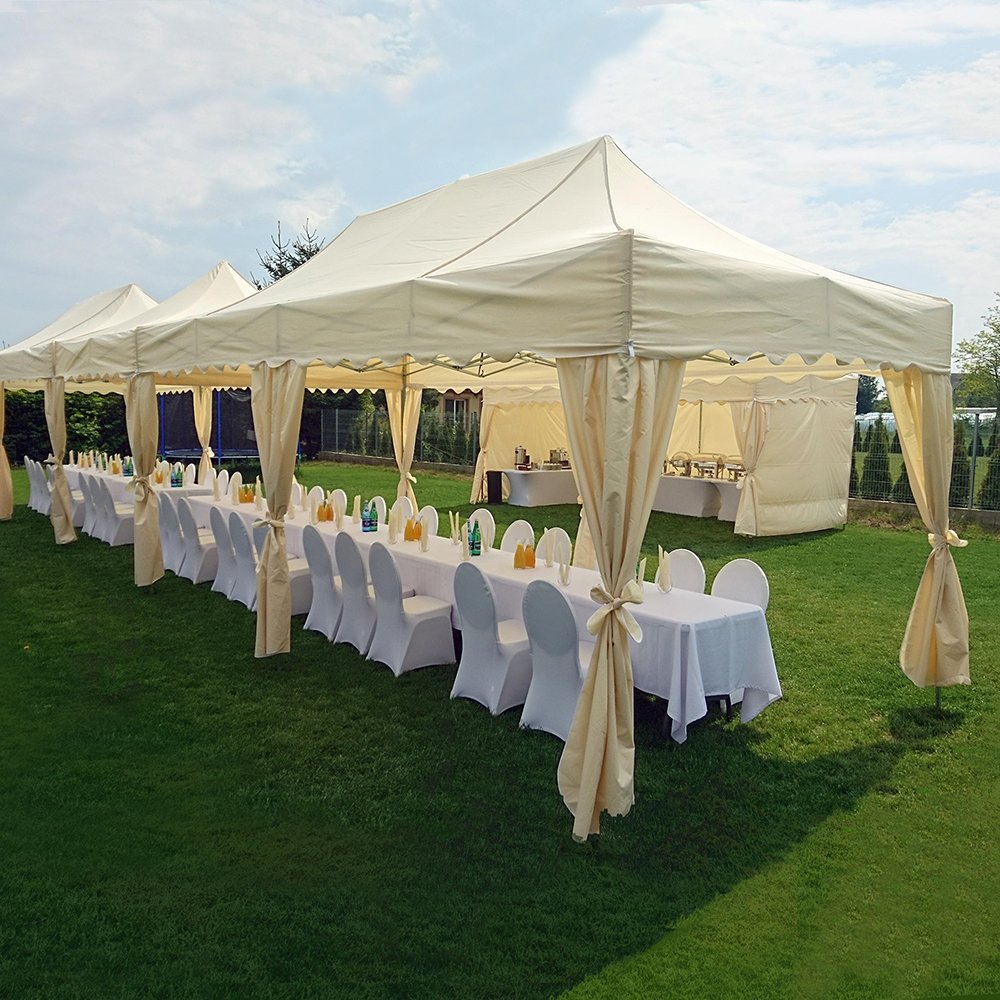
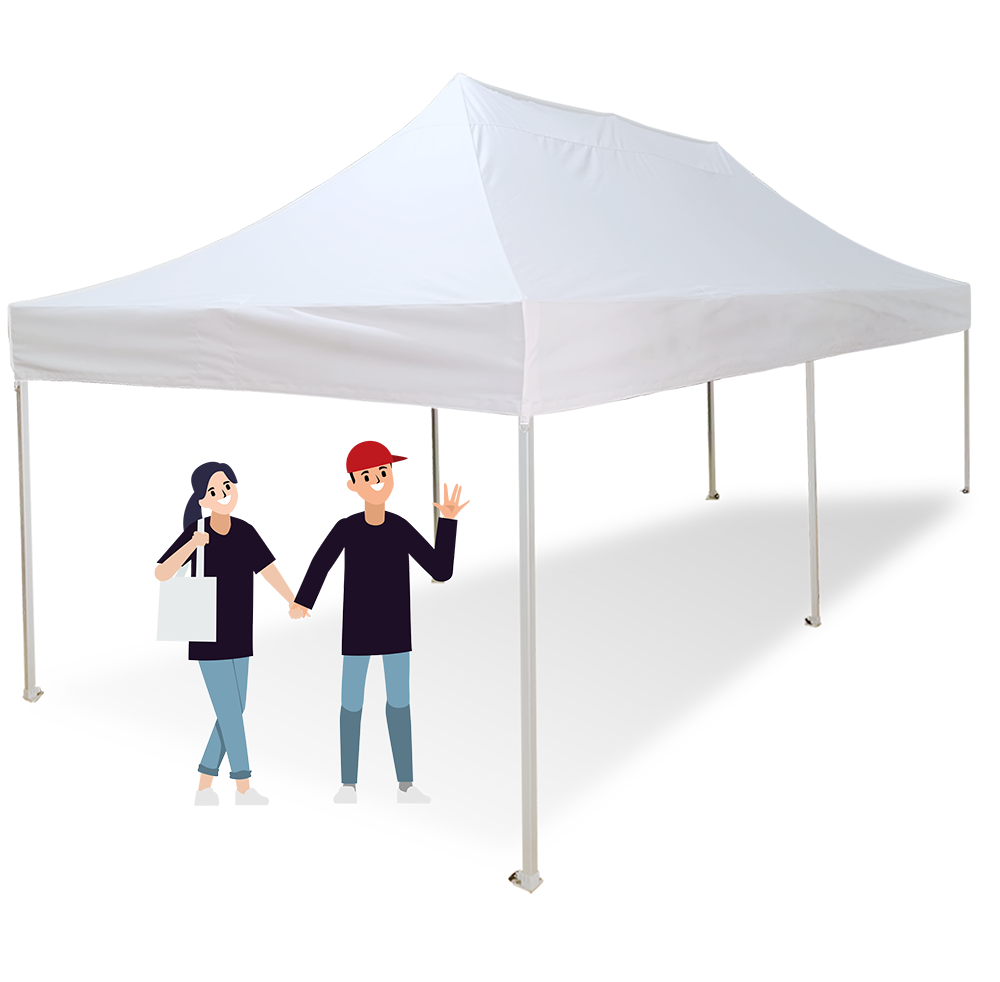

10. An Exhibition Tent Factory Should Control Waterproofing and Weather Performance
Outdoor exhibition tents can encounter rain, wind, sunlight, dust, and repeated installation.
Waterproofing is therefore an important manufacturing consideration.
Water can enter through several potential pathways:
- Fabric surface
- Sewing holes
- Seams
- Fermetures à glissière
- Roof joints
- Damaged coatings
- Poorly tensioned fabric
Un professionnel exhibition tent factory should consider the complete waterproofing system rather than simply claiming that the fabric is waterproof.
Fabric coating, seam construction, roof tension, sewing quality, and panel design all influence real-world performance.
For outdoor applications, customers should also ask the manufacturer how the tent is intended to be anchored.
No portable tent should be considered automatically safe in severe weather simply because the fabric is waterproof.
A responsible exhibition tent manufacturer should explain the difference between weather resistance, waterproofing, and structural wind performance.
11. Custom Exhibition Tent Manufacturing Requires Accurate Quality Control
A major difference between an experienced exhibition tent factory and a low-cost supplier is quality-control discipline.
A complete quality-control process can include:
Incoming Material Inspection
The factory checks fabrics, aluminum profiles, hardware, printing materials, and accessories before production.
Cutting Inspection
Fabric dimensions must match the production pattern.
Printing Inspection
Graphics, colors, logos, and positioning should be checked.
Sewing Inspection
The factory checks seams, reinforcement, zippers, Velcro, and dimensions.
Frame Inspection
The structure should be checked for dimensions, movement, locking, and component installation.
Assembly Inspection
The factory can assemble representative units to confirm that fabric and frame fit correctly.
Final Inspection
The finished product should be checked before packaging.
This multi-stage approach reduces the risk of receiving a tent that looks correct in photographs but does not assemble properly on site.
12. Repeat-Order Consistency Is an Important Exhibition Tent Factory Advantage
For brands, the first order is often not the final order.
A company may initially purchase 20 10×10 exhibition tents, then expand to 100 or several hundred units for regional marketing campaigns.
If the factory cannot maintain production consistency, the customer may receive different colors, dimensions, frame structures, or graphic positioning in later batches.
Un professionnel exhibition tent factory should therefore maintain production records.
Important specifications can include:
- Fabric specification
- Couleur du tissu
- Printing profile
- Artwork files
- Frame dimensions
- Hardware specification
- Sewing patterns
- Packaging method
- Accessory configuration
This becomes especially valuable for international brands operating multiple events.
Consistent manufacturing allows the same visual identity to be reproduced across different locations.
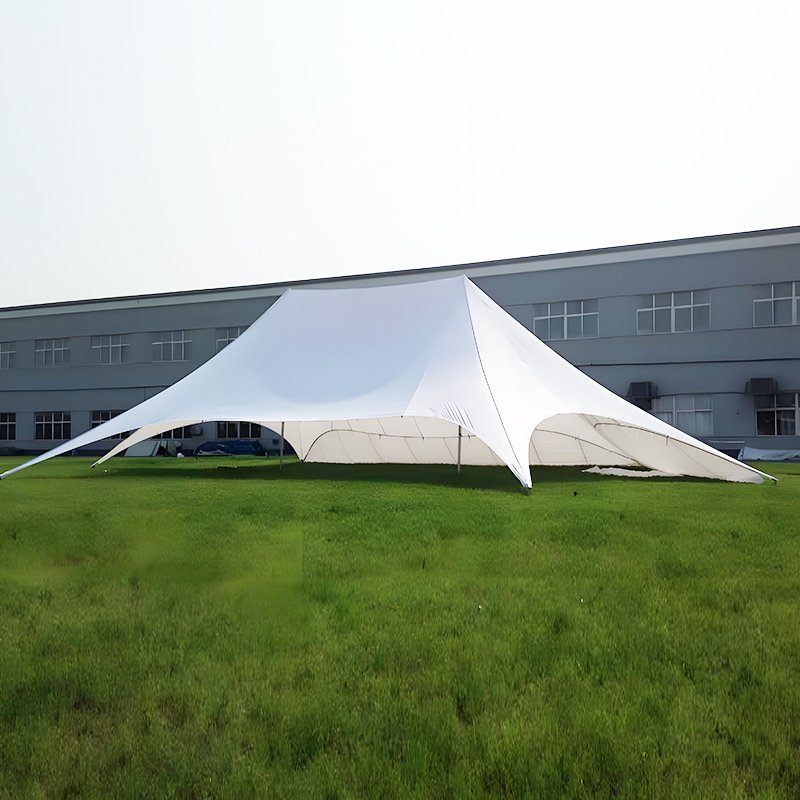
13. Exhibition Tent Factory Capability Should Include OEM and Brand Customization
Many companies do not want generic tents.
They want a display system that looks like their own brand.
For this reason, OEM capability is an important consideration when selecting an exhibition tent manufacturer.
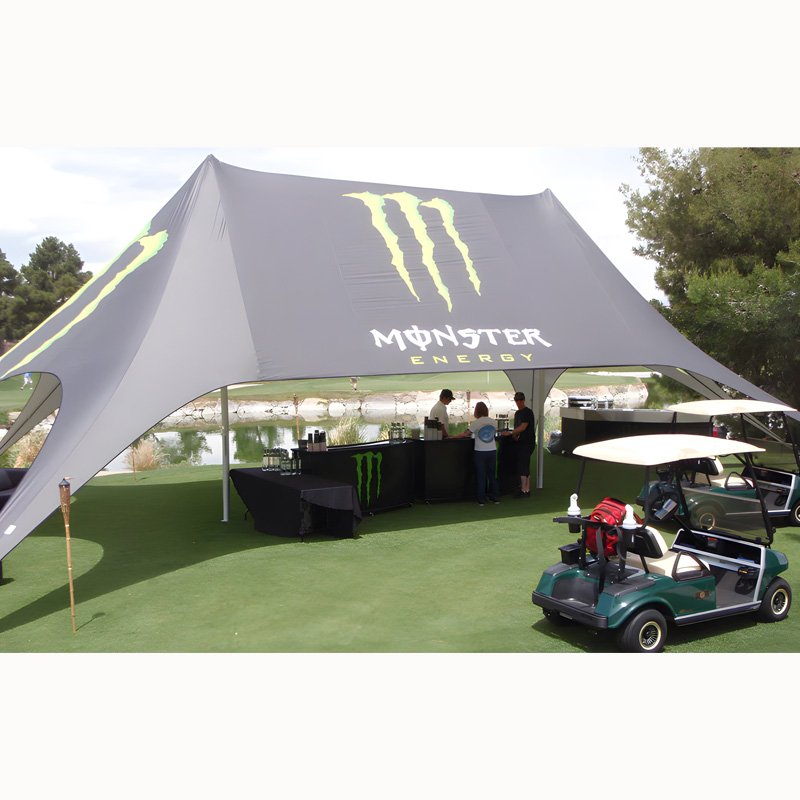
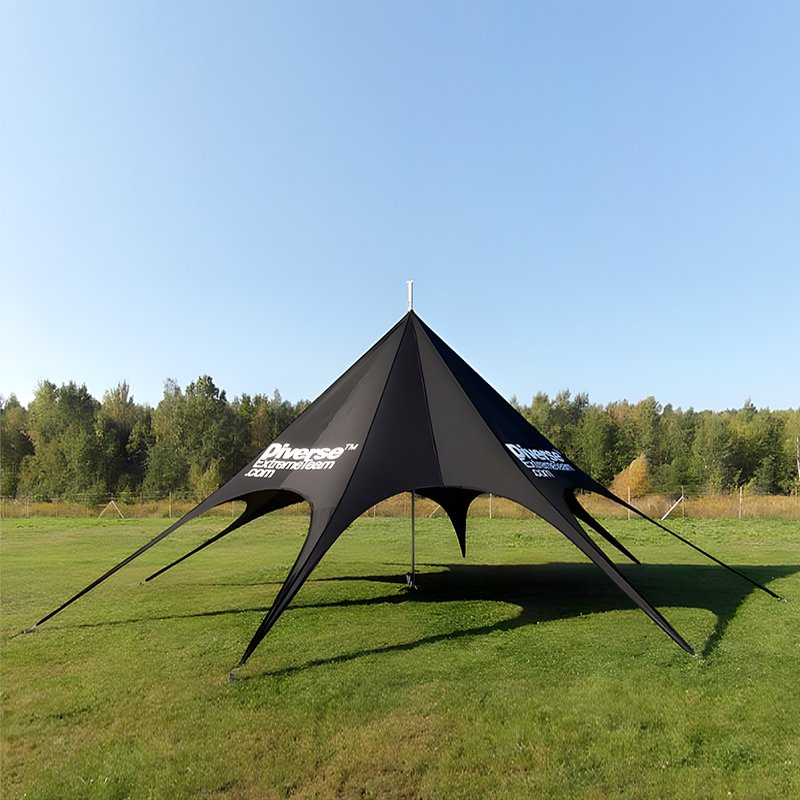
Dtent can work with customers on customized:
- Dimensions de la tente
- Brand logos
- Graphiques en couleur
- Roof printing
- Sidewall printing
- Valance printing
- Backwall graphics
- sélection de tissus
- Frame specifications
- Accessoires
- Conditionnement
A brand can provide its existing artwork, or the manufacturing team can work from technical requirements and prepare production specifications.
This makes the process more suitable for companies that want a complete custom exhibition tent rather than an off-the-shelf canopy.
14. Why Choose Dtent as Your Exhibition Tent Factory?
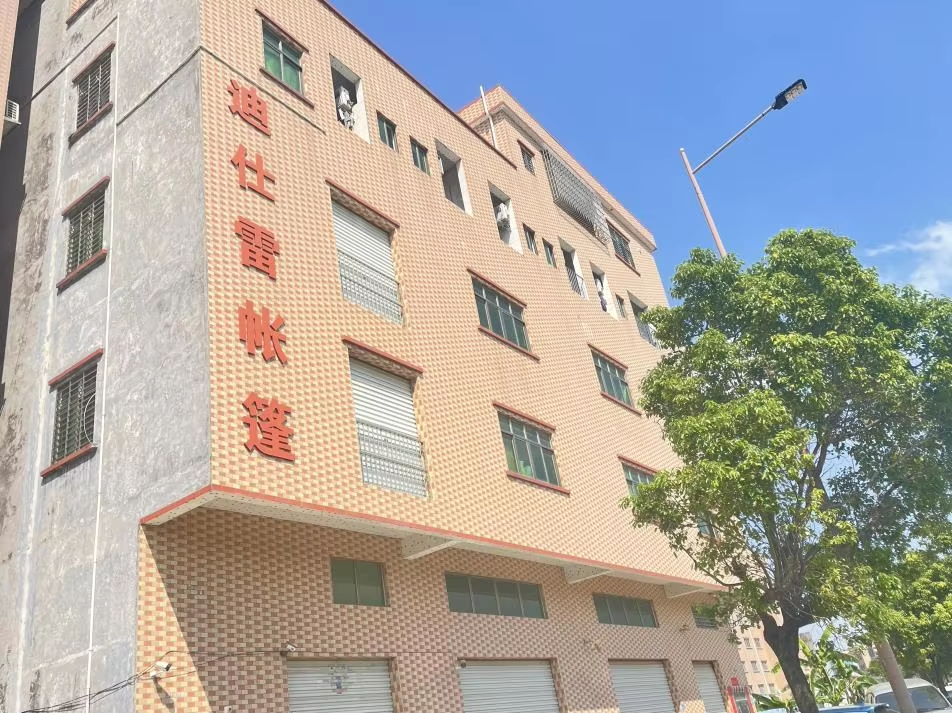
Dtent is a professional custom tent manufacturer with more than 10 years of experience in tent manufacturing and a 6,000㎡ factory.
The company’s experience covers commercial tents, event tents, exhibition tents, pop-up canopies, and other customized temporary structures.
For brands looking for an exhibition tent factory, Dtent provides several important advantages.
10+ Years of Manufacturing Experience
Long-term manufacturing experience provides practical knowledge of materials, structures, sewing, printing, and production challenges.
Usine de fabrication de 6 000 m²
A dedicated production facility provides the manufacturing space required for material preparation, printing, sewing, assembly, inspection, and packaging.
Custom Manufacturing
Dtent does not limit customers to standard products. The factory can work around the customer’s application, dimensions, graphics, logo, and branding requirements.
Brand Printing
Customers can provide their own logo, graphics, artwork, and brand identity for printing on the exhibition tent.
Capacité OEM
Dtent can cooperate with brands that require customized products for their own markets and marketing campaigns.
Long-Term Production Support
For customers requiring repeat orders, consistent specifications and production standards are important parts of long-term cooperation.
For these reasons, Dtent can be considered by brands searching for a reliable exhibition tent manufacturer ou exhibition tent factory for customized commercial applications.
15. How to Choose the Right Exhibition Tent Factory: A Buyer Checklist
Before placing an order, buyers should evaluate more than the factory’s quotation.
A practical checklist includes:
| Evaluation Item | What Buyers Should Check |
|---|---|
| Factory Experience | Years of actual tent manufacturing |
| Factory Size | Production capacity and facilities |
| Cadre | Material, profile, connectors and locking system |
| Tissu | Weight, coating, printing compatibility |
| Impression | Resolution, color consistency and durability |
| Couture | Stitch quality and reinforcement |
| Personnalisation | Size, structure, artwork and accessories |
| Contrôle de la qualité | Inspection process and assembly testing |
| OEM | Ability to produce for brands |
| Repeat Orders | Specification and color consistency |
| Conditionnement | Protection and transportation efficiency |
| Communication | Technical response and engineering support |
A low quotation may initially look attractive, but the total cost of an exhibition tent should include product durability, printing quality, transportation, replacement rates, installation time, and long-term consistency.
Le meilleur exhibition tent factory is not necessarily the factory with the lowest unit price.
It is the factory that provides the right balance of:
Design + Engineering + Materials + Manufacturing + Printing + Quality + Service.
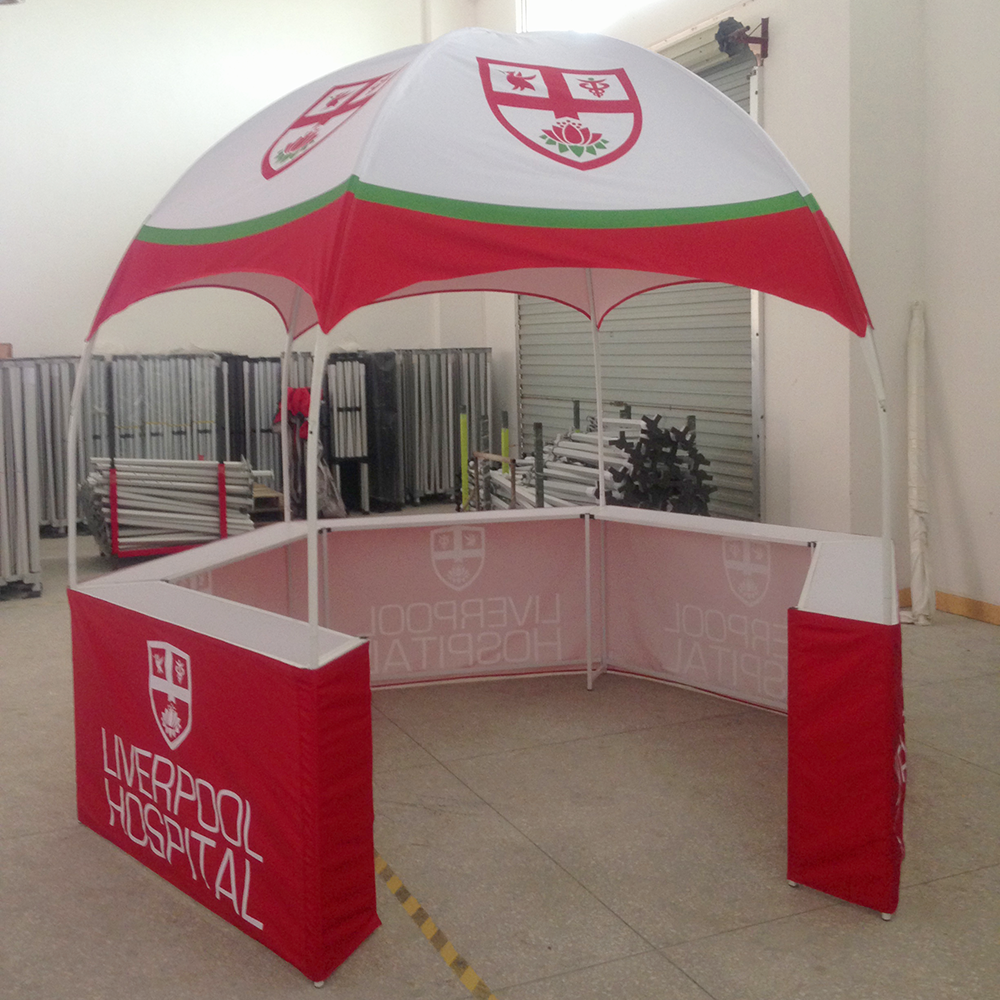


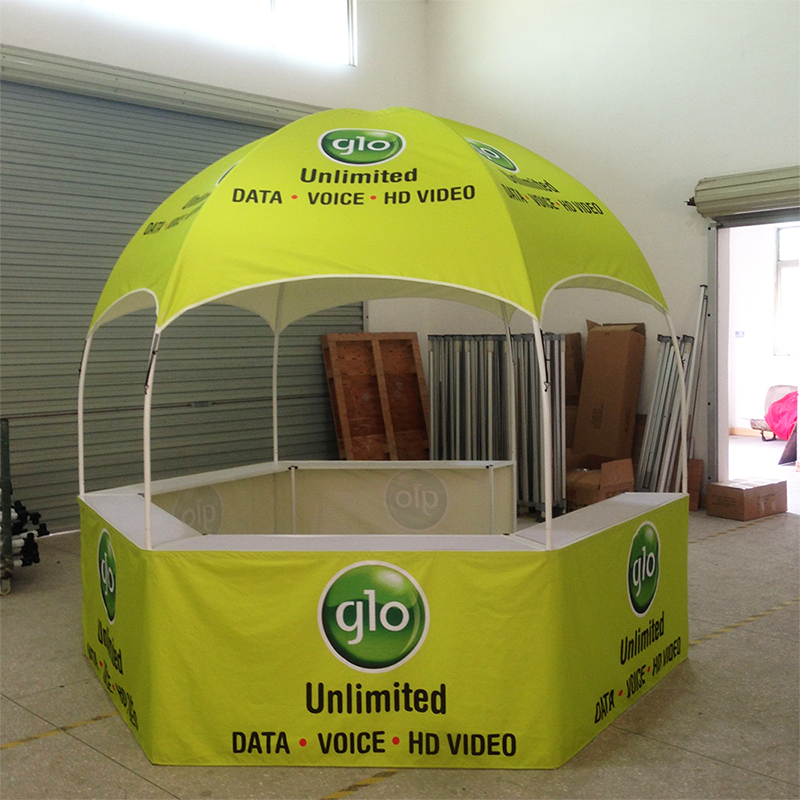
16. Exhibition Tent Factory Selection Should Start with the Final Application
One of the most common purchasing mistakes is selecting an exhibition tent based only on photographs.
Two tents can look almost identical online while having very different internal structures, materials, printing processes, and component quality.
Before contacting an exhibition tent factory, brands should define:
- Where the tent will be used
- Indoor or outdoor environment
- Required tent size
- Expected number of users
- Frequency of setup
- Required branding areas
- Required accessories
- Limitations de transport
- Target service life
- Local safety requirements
For example, a brand attending indoor exhibitions may prefer a lightweight 10×10 exhibition tent with high-quality graphics and convenient transportation.
An outdoor event company may need a stronger frame, waterproof fabric, reinforced sewing, ballast compatibility, and weather-resistant graphics.
The factory’s role is to convert these requirements into a practical product specification.
17. Frequently Asked Questions About Exhibition Tent Factories
What does an exhibition tent factory manufacture?
An exhibition tent factory manufactures temporary structures designed for trade shows, exhibitions, marketing events, promotional campaigns, sporting events, corporate activities, and commercial displays. Products may include exhibition tents, pop-up canopies, commercial tents, printed tents, sidewalls, frames, and accessories.
What is a custom exhibition tent?
A custom exhibition tent is a tent manufactured according to a customer’s specific requirements, such as dimensions, frame structure, fabric, colors, graphics, logos, sidewalls, accessories, and packaging.
What is the most popular exhibition tent size?
The 10×10 exhibition tent is one of the most popular configurations because it provides a practical balance between usable space, portability, branding area, and transportation efficiency. However, 10×15, 10×20, 20×20, and other custom sizes are also widely used.
Can an exhibition tent be fully printed?
Yes. Depending on the fabric and printing technology, an exhibition tent can have customized graphics on the roof, valances, sidewalls, backwalls, and other fabric components.
How do I choose an exhibition tent manufacturer?
Evaluate the manufacturer’s experience, factory capacity, frame engineering, fabric quality, printing technology, sewing quality, customization capability, quality-control process, OEM capability, and ability to maintain consistency for repeat orders.
Can Dtent manufacture tents using our own logo and design?
Yes. Dtent provides custom manufacturing services for brands and can produce exhibition tents using customer-provided logos, artwork, colors, and other branding requirements.
Is a 10×10 exhibition tent suitable for outdoor events?
A 10×10 exhibition tent can be suitable for many outdoor applications when it is properly configured and securely anchored. The appropriate frame, fabric, anchoring, ballast, and weather requirements should be determined according to the event environment.
Choose an Exhibition Tent Factory That Understands Your Brand
An exhibition tent is not simply fabric stretched over a frame.
It is a complete commercial display system consisting of structural engineering, textile selection, printing, sewing, hardware, branding, transportation, and installation.
For brands that need a reliable custom exhibition tent, the choice of manufacturing partner can directly influence the final appearance, durability, consistency, and user experience of the product.
Un professionnel exhibition tent factory should be able to understand the customer’s application, recommend suitable materials and structures, accurately reproduce brand graphics, control manufacturing quality, and support repeat production.
Dtent combines more than 10 years of custom tent manufacturing experience with a 6,000㎡ production facility and customized OEM capabilities. The company can manufacture commercial tents, event tents, exhibition tents, pop-up canopies, and other branded temporary structures according to customer requirements.
For brands searching for an exhibition tent manufacturer, custom exhibition tent supplier, or reliable exhibition tent factory, Dtent can provide a factory-direct solution covering customization, printing, manufacturing, quality control, and long-term production support.
The right exhibition tent should not only protect people from the environment. It should also make the brand more visible, more professional, and more memorable.
That is why choosing the right exhibition tent factory is an important part of building a successful event and exhibition marketing system.
Vous êtes une société commerciale ou un fabricant ?
Nous sommes un fabricant spécialisé dans les tentes pliantes, les parapluies d'extérieur, les drapeaux de plage et les bannières publicitaires.
Pouvez-vous réaliser un design à partir de mes idées ou de mes dessins ?
Oui, nous avons des concepteurs expérimentés et notre propre usine de moulage. En fonction de vos besoins, nous pouvons concevoir ou ouvrir des moules à des prix compétitifs.
Combien de temps dure l'échantillonnage ?
Les échantillons seront prêts dans un délai de 5 à 7 jours, en fonction de vos exigences en matière d'impression et de matériaux.
Quel est votre avantage ?
Efficacité des coûts ; prix bas ; Efficacité des délais : nous nous engageons à effectuer les livraisons de masse dans les 30 jours Efficacité des services : nos vendeurs s'engagent à répondre à votre demande dans les 12 heures : Nos vendeurs s'engagent à répondre à votre demande dans les 12 heures. whatsapp 86 180 3827 3926