
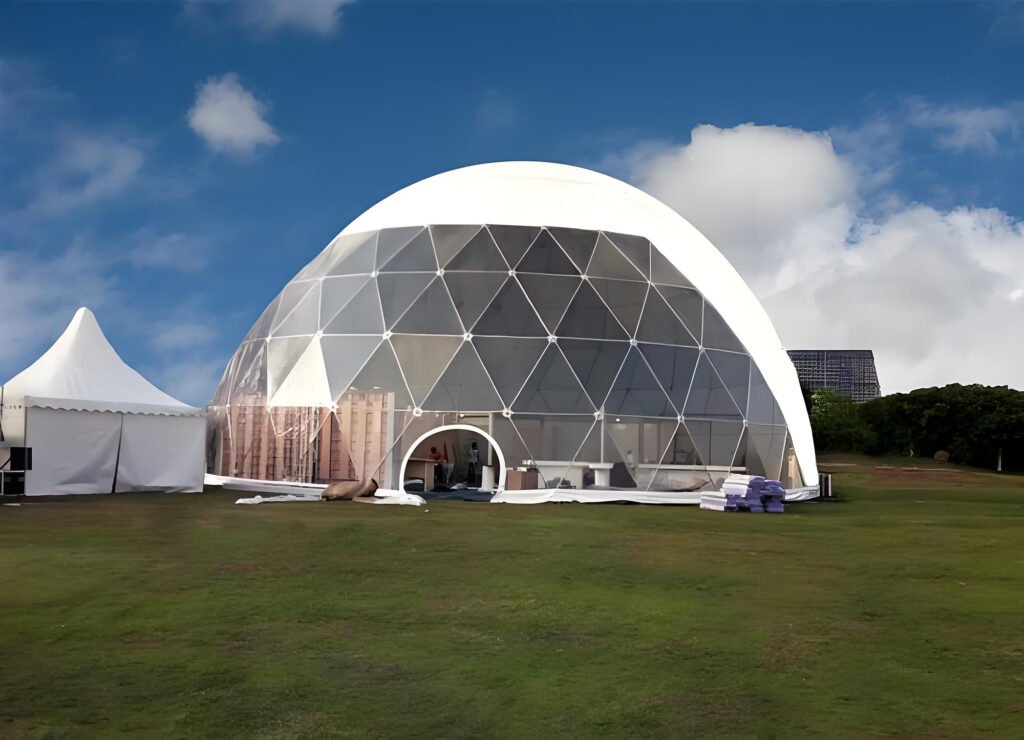
One of the most attractive features of a modern dome tent is its transparent viewing area.
Whether used for:
- Luxury glamping
- Outdoor events
- Brand activations
- Restaurants
- Winter lounges
- Exhibition spaces
The clear panoramic window creates an immersive experience that standard tents cannot match.
However, many dome tent owners encounter an unexpected problem after only one season of use:
The once crystal-clear transparent panel starts to look:
- Foggy
- Hazy
- Milky
- Scratched
- Covered with tiny spider-web cracks
Some customers even assume that the material is defective.
Others wonder:
“Is my dome tent window deteriorating from UV exposure?”
“Did the manufacturer use cheap PVC?”
“Can these cracks spread and eventually cause failure?”
“How can I prevent this from happening on my next dome tent purchase?”
As a professional dome tent manufacturer with over 10 years of experience designing and manufacturing commercial event tents, geodesic domes, glamping domes, and custom structures, Dtent frequently helps customers diagnose what engineers call:
Crazing
Crazing is one of the most misunderstood failure mechanisms in transparent dome materials.
The good news:
In many cases, it can be prevented.
The better news:
Understanding the real causes helps buyers choose a higher-quality dome tent and dramatically extend its service life.
What Is "Crazing" in a Dome Tent?
Crazing refers to the formation of microscopic cracks within transparent plastic materials.
Unlike a visible fracture, crazing often begins as:
- Fine white lines
- Cloudy patches
- Hazy areas
- Spider-web patterns
Initially, the material may still appear structurally intact.
However, under magnification, thousands of tiny cracks can often be observed.
These cracks scatter light.
This is why the transparent section begins to look:
- Foggy
- Frosted
- Milky
Even though the surface may still feel smooth.
Why Transparent Dome Tent Panels Are Vulnerable
Unlike fabric covers, transparent sections typically use plastic materials such as:
Clear PVC
Common in event domes.
TPU
Increasingly used in premium structures.
Polycarbonate
High-end architectural applications.
Acrylic
Occasionally used in rigid dome systems.
Each material has unique advantages.
However, all transparent polymers face the same challenge:
Environmental Aging
Outdoor exposure is extremely demanding.
The material must withstand:
- UV radiation
- Heat
- Cold
- Wind
- Moisture
- Expansion and contraction
- Mechanical stress
Over time, these factors accumulate.
Eventually, crazing begins.


Is UV Stabilizer Failure the Main Cause?
The short answer:
Sometimes
But not always.
Many buyers assume UV exposure is solely responsible.
The reality is more complex.
UV degradation is often one factor among several.
In professional failure analysis, crazing typically results from a combination of:
- UV aging
- Mechanical stress
- Chemical exposure
- Material quality
- Installation conditions
Let’s examine each factor.
Cause #1: UV Radiation Breakdown
UV exposure is the most common contributor to transparent dome deterioration.
Sunlight contains ultraviolet energy capable of breaking molecular bonds within plastics.
Over time:
The polymer structure weakens.
Consequences include:
- Reduced flexibility
- Surface oxidation
- Discoloration
- Embrittlement
- Micro-cracking
Once flexibility decreases, tiny stress cracks begin forming.
This is the beginning of crazing.
Why Cheap Dome Tent Windows Fail Faster
Not all transparent materials contain the same UV protection.
Low-cost suppliers often reduce costs by using:
- Lower-grade PVC
- Minimal UV additives
- Recycled resin content
Initially, these materials may look identical to premium alternatives.
After six to twelve months outdoors, differences become obvious.
A high-quality UV package may double or triple service life.
This is one reason experienced buyers evaluate the entire specification rather than simply comparing prices.
Cause #2: Thermal Expansion and Contraction
One of the most overlooked causes of dome tent crazing is temperature cycling.
Transparent panels experience significant temperature swings.
For example:
Midday Summer
Surface temperature:
140°F–180°F (60°C–82°C)
Night
Surface temperature:
50°F–70°F (10°C–21°C)
This daily expansion and contraction creates stress.
Over months:
Microscopic fatigue develops.
Eventually:
Hairline cracks appear.
Why Dome Tent Geometry Increases Stress
A dome tent is not a flat structure.
The transparent window is continuously subjected to:
- Curvature
- Tension
- Wind loading
Unlike architectural glass, flexible window materials constantly move.
Every gust of wind introduces stress cycles.
These repetitive loads accelerate crazing.
Cause #3: Excessive Fabric Tension
Many installers unknowingly create conditions that promote cracking.
A common mistake is over-tensioning the transparent panel.
The reasoning seems logical:
Tighter fabric looks better.
However:
Excessive tension creates permanent stress within the material.
When combined with:
- UV exposure
- Temperature fluctuations
- Wind loads
Micro-cracks develop much faster.
Professional dome tent manufacturers carefully specify allowable tension levels.
Cause #4: Chemical Damage
This is one of the least understood causes of crazing.
Many cleaning products contain chemicals that attack transparent polymers.
Common culprits include:
Ammonia-Based Cleaners
Often found in household glass cleaners.
Solvents
Can weaken plastic structures.
Alcohol-Based Products
Repeated use may accelerate aging.
Harsh Degreasers
Can remove protective surface treatments.
The damage may not be immediately visible.
Weeks later:
Fine cracks begin appearing.
Why Improper Cleaning Causes Fogging
Many dome tent owners aggressively scrub transparent windows.
This creates:
- Surface abrasion
- Micro-scratches
- Reduced clarity
These tiny scratches scatter light.
The result:
A cloudy appearance often mistaken for UV damage.
Cause #5: Inferior Plastic Formulations
Two clear PVC sheets may look identical.
Yet their performance can differ dramatically.
Key quality factors include:
UV Stabilizer Content
Plasticizer Quality
Resin Purity
Manufacturing Consistency
Coating Technology
Low-cost materials frequently contain:
- More fillers
- Less UV protection
- Lower-quality additives
These factors increase crazing risk.
PVC vs TPU: Which Performs Better?
Many premium dome tent manufacturers are increasingly adopting TPU windows.
Let’s compare.
PVC
Advantages:
- Lower cost
- Easy fabrication
- Good transparency
Disadvantages:
- More susceptible to yellowing
- Lower long-term flexibility
TPU
Advantages:
- Better elasticity
- Superior UV resistance
- Improved crack resistance
Disadvantages:
- Higher cost
For long-term installations, TPU often provides better durability.
Why Fogging Happens Before Cracks Appear
Many customers notice fogging first.
This is an important warning sign.
The process typically follows:
Stage 1
Loss of surface gloss.
Stage 2
Hazy appearance.
Stage 3
Micro-crazing develops.
Stage 4
Visible hairline cracks.
Stage 5
Structural weakening.
Identifying issues early can prevent costly replacements.
How to Inspect Your Dome Tent for Early Crazing
Perform periodic inspections.
Look for:
Cloudy Areas
Especially around attachment points.
Fine White Lines
Often visible in direct sunlight.
Reduced Transparency
Compare with new sections if possible.
Surface Roughness
May indicate material degradation.
Early detection allows preventative action.
Can Crazed Dome Tent Windows Be Repaired?
Unfortunately:
Not completely.
Once crazing develops inside the polymer structure, restoration is difficult.
Minor surface hazing may be improved through polishing.
However:
Internal cracks cannot usually be removed.
Replacement is often the safest solution.
How to Prevent Dome Tent Crazing
Choose UV-Stabilized Materials
Request documented UV protection specifications.
Not marketing claims.
Avoid Over-Tensioning
Follow manufacturer guidelines.
Excessive tension accelerates fatigue.
Use Proper Cleaning Products
Use:
- Mild soap
- Soft microfiber cloths
- Non-abrasive cleaners
Avoid harsh chemicals.
Reduce Continuous UV Exposure
If practical:
- Use shade structures
- Apply protective covers during storage
Select Premium Window Materials
For commercial applications:
TPU often outperforms standard PVC.
Questions to Ask a Dome Tent Manufacturer
Before purchasing, ask:
What material is used for transparent panels?
Is the material UV stabilized?
What is the expected outdoor lifespan?
Has the window material undergone accelerated weather testing?
Is TPU available as an upgrade?
What warranty applies to transparent components?
A reputable dome tent factory should answer these questions clearly.
How Dtent Addresses Dome Tent Window Durability
As an experienced dome tent manufacturer, Dtent understands that transparent sections are often the most visually important part of the structure.
Our engineering approach focuses on:
Premium Material Selection
We carefully evaluate:
- UV resistance
- Optical clarity
- Long-term flexibility
Controlled Fabric Tension
Proper design reduces unnecessary stress on transparent components.
Commercial-Grade Manufacturing
We prioritize durability over short-term cost savings.
Custom Solutions
Depending on project requirements, we can recommend:
- PVC window systems
- Enhanced UV-resistant materials
- TPU transparent panels
- Long-term installation solutions
The Future of Transparent Dome Tent Technology
The industry is moving toward advanced materials that offer:
Improved UV Resistance
Self-Cleaning Surfaces
Enhanced Optical Clarity
Better Flexibility
Longer Service Life
These innovations are helping modern dome tents achieve significantly longer lifespans than earlier generations.
Why Dome Tent Windows Become Foggy and Develop Hairline Cracks
The “crazing” issue is rarely caused by a single factor.
Instead, it usually results from the interaction of:
- UV exposure
- Heat
- Mechanical stress
- Improper cleaning
- Material quality
- Installation practices
While UV stabilizer failure can contribute to the problem, it is often only part of the story.
The best prevention strategy is to choose a high-quality dome tent from an experienced dome tent manufacturer, specify UV-stabilized materials, avoid excessive tension, and follow proper maintenance procedures.
When evaluating a dome tent factory, don’t focus solely on frame specifications or fabric weight. The quality of the transparent dome section often determines how the structure will look after one season, three seasons, or five years of outdoor use. A crystal-clear dome today should still be a crystal-clear dome years from now—and that outcome starts with material selection and engineering quality.
Are you a Trading Company or Manufacturer?
We are a manufacturer specialized in Folding tents, Outdoor umbrellas, Beach flags, Advertising Banners
Can you do design for my ideas or drawing?
Yes, we have experienced designers and our own molding factory. According to your requirements, we can design or open mold which has a competitive price.
How long does sample take?
Sample will be ready within 5-7 days, depends on your printing and material requirements.
What is your advantage?
Cost effective; with low price; Time effective: we promise to make the mass delivery within 30 days Service effective: Our sales people promise to reply your enquiry within 12 hours.Contact whatsapp 86 180 3827 3926