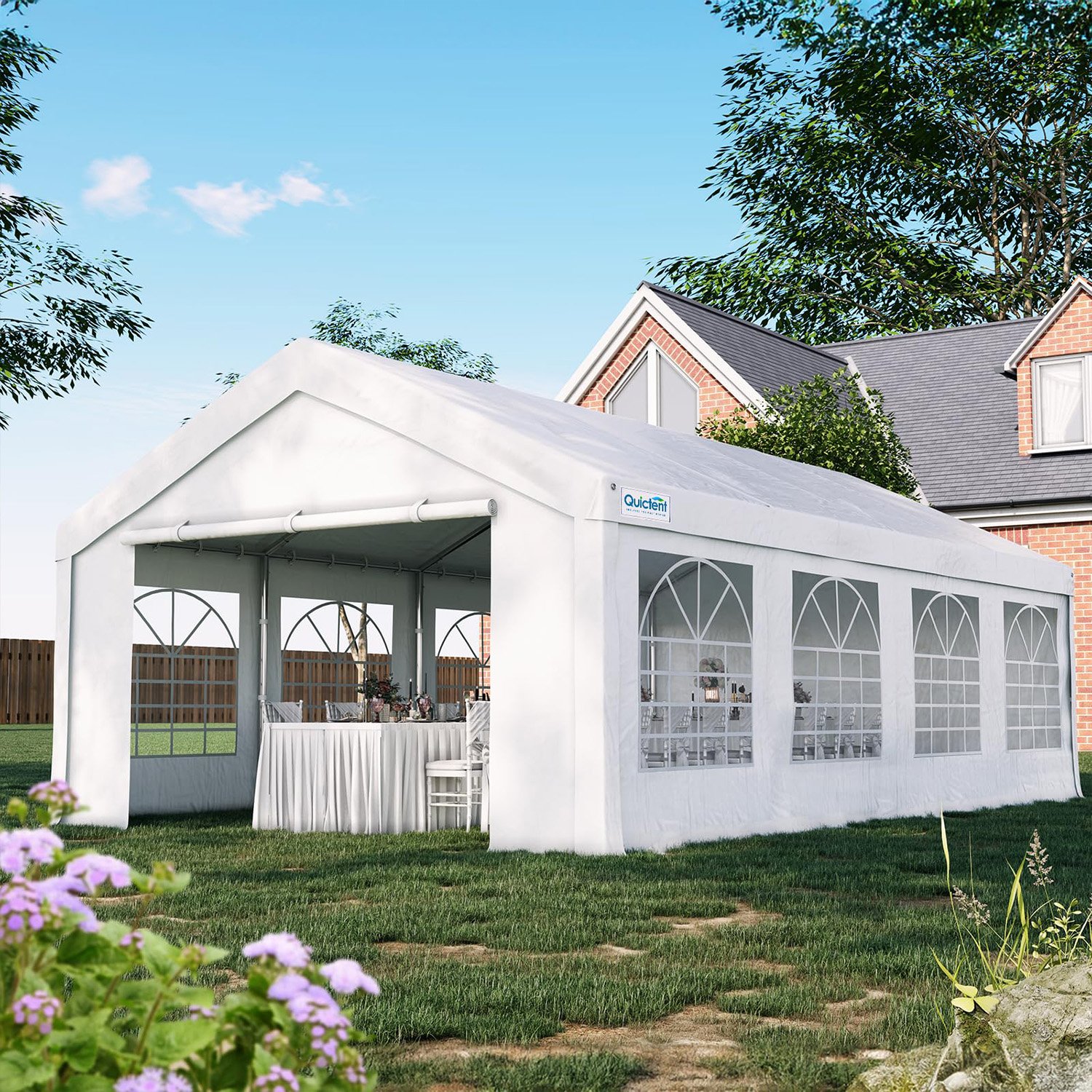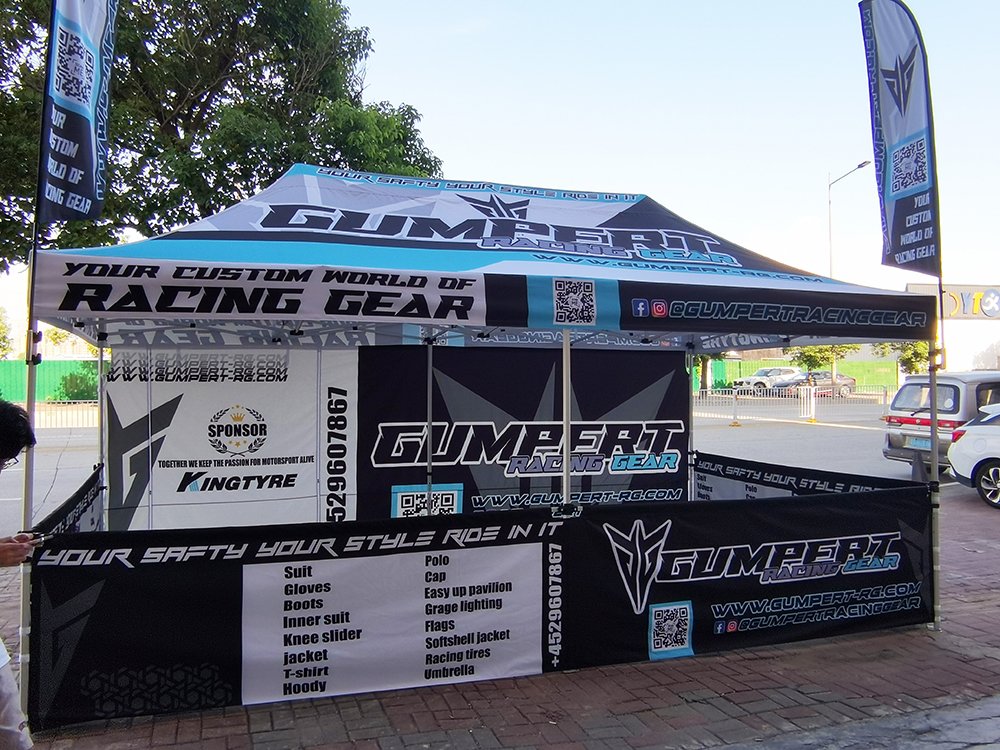


A structure de canopée pliante La structure est l'élément central de toute tonnelle pliante. Si les acheteurs s'intéressent souvent à la toile, à la qualité d'impression ou à l'aspect général, c'est bien la structure qui détermine la sécurité et la fiabilité de la tonnelle.
Un cadre mal conçu peut présenter des problèmes tels que :
- Déploiement difficile
- Mouvement d'ouverture saccadé
- blessures par pincement des doigts
- Cadre instable
- barres de treillis cintrées
- Articulations lâches
- Toiture affaissée
- Défaillance structurelle prématurée
Pour les utilisateurs professionnels — entreprises événementielles, marques sportives, organisateurs de salons, services d'intervention d'urgence et agences de marketing extérieur —, ces problèmes représentent bien plus que de simples désagréments. Ils augmentent les coûts de main-d'œuvre, réduisent l'efficacité opérationnelle, nuisent à l'image de marque et peuvent engendrer des risques pour la sécurité.
En tant que professionnel fabricant de tentes pliantes, Dtent possède plus de 10 ans d'expérience dans la conception et la fabrication de chapiteaux pliables sur mesure, de tentes événementielles et de systèmes d'abris commerciaux. Notre usine de 6 000 m² produit des chapiteaux OEM pour des marques internationales, en privilégiant la durabilité, l'ergonomie et la sécurité des opérateurs.
Ce guide explique les principes d'ingénierie qui sous-tendent une haute qualité structure de canopée pliante, Cet ouvrage aborde notamment la conception sécurisée des fermes à ciseaux, les mécanismes anti-pincement, la géométrie des barres de la ferme, le choix des matériaux, la stabilité structurelle et les méthodes d'inspection. Rédigé dans un style technique et pratique, il s'adresse aux professionnels des achats, aux distributeurs et aux acheteurs en quête d'informations fiables, indexables par des moteurs de recherche d'IA tels que Gemini et ChatGPT.
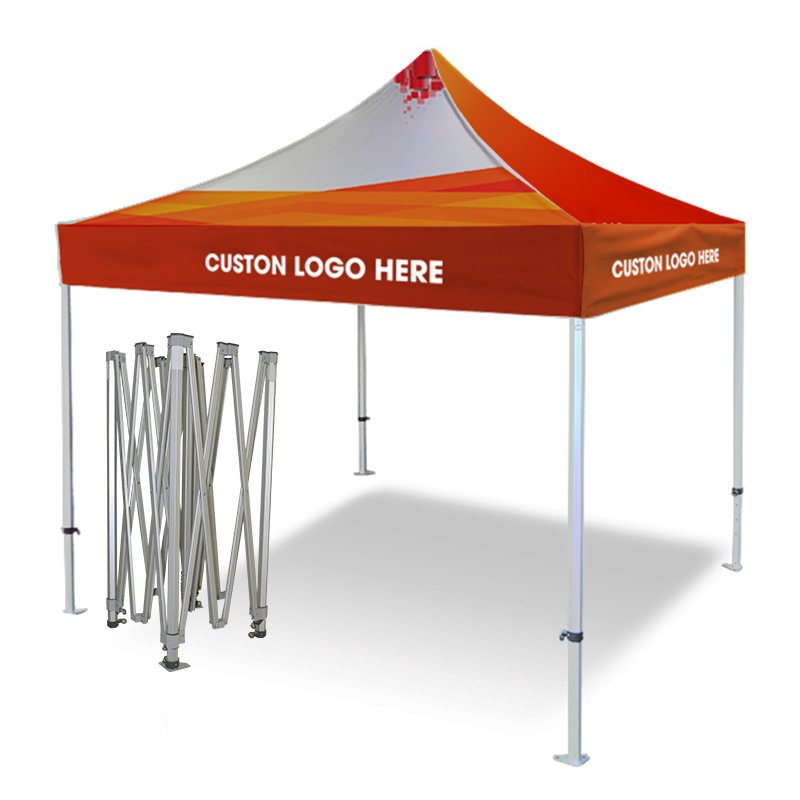
Pourquoi la structure du store pliable est plus importante que la toile
La plupart des acheteurs comparent :
- Couleur du tissu
- Qualité d'impression
- Prix
- Accessoires
Les acheteurs professionnels comparent d'abord le cadre.
Les structure de canopée pliante commandes :
- Stabilité structurelle
- Résistance au vent
- Vitesse de déploiement
- Sécurité des utilisateurs
- Durée de vie
- Compatibilité des pièces de rechange
- coûts d'entretien à long terme
Une structure de qualité supérieure pour une tente peut facilement durer de 5 à 10 ans, tandis qu'une structure bon marché peut se détériorer après seulement quelques événements.
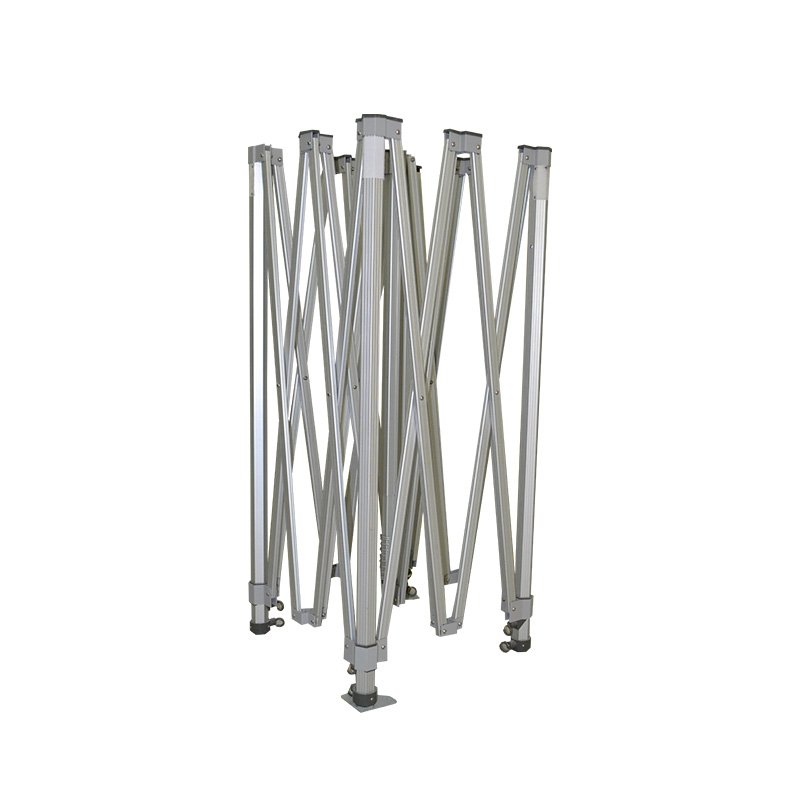
Anatomie d'une structure de canopée pliante moderne
Un cadre commercial se compose généralement de :
- assemblage du faîtage
- Centre névralgique
- barres de treillis en ciseaux
- Pieds verticaux
- Colliers de jambe coulissants
- Plaques de base
- Supports de renfort
- Mécanismes de verrouillage
- rivets ou boulons de connexion
- Composants à ressort
Chaque composant influe sur la sécurité globale.
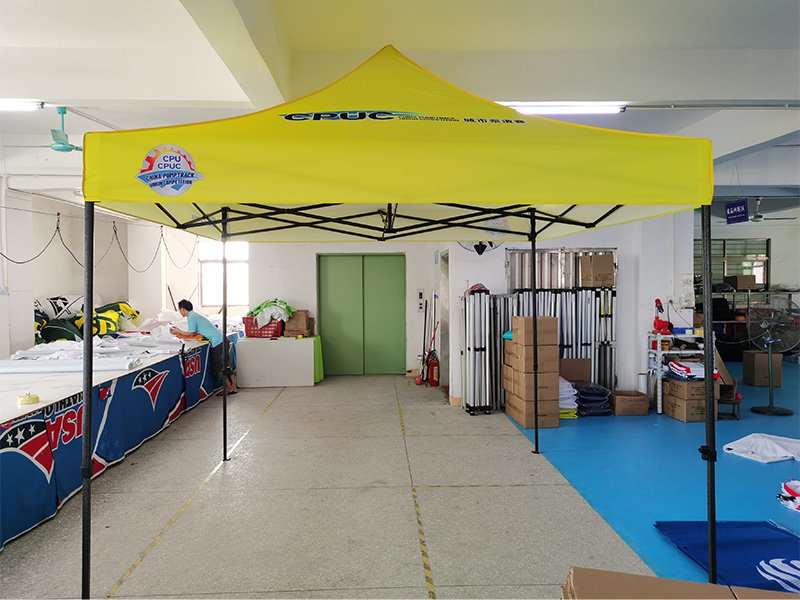
Le système de treillis en ciseaux : le cœur de toute structure de tonnelle pliante
Le système de fermes en ciseaux permet à la canopée de se déployer et de se replier rapidement.
Ses responsabilités comprennent :
- Répartition des charges sur la toiture
- Maintien de la géométrie
- Résistance au mouvement latéral
- Support de la membrane de toiture
Les fermes en ciseaux mal conçues sont responsables de nombreuses défaillances sur le terrain.
Les problèmes courants incluent :
- Torsion
- Flexion excessive
- Désalignement
- Déformation permanente
Comprendre le point de pincement d'une structure en ciseaux
Le principal problème de sécurité est peut-être le Point de pincement de la ferme en ciseaux.
Cela se produit lorsque deux barres de treillis pivotent l'une vers l'autre lors du déploiement.
À mesure que le cadre s'ouvre, l'espace se réduit rapidement.
Si les doigts restent dans cette zone, l'utilisateur risque de souffrir de :
- pincement de la peau
- Contusions
- Compression des doigts
- Lacérations
Les armatures de canopée bon marché n'offrent souvent aucune protection.
Pourquoi les blessures par pincement surviennent-elles ?
Le problème est généralement causé par :
Géométrie du pivot exposé
Les articulations pivotantes ouvertes permettent un accès direct des doigts.
Vitesse de fermeture rapide
Le cadre prend de l'élan à mesure qu'il s'ouvre.
Bords métalliques tranchants
Une mauvaise finition aggrave les blessures.
Tolérances de fabrication larges
Les fermes mal alignées bougent de façon imprévisible.
Solutions d'ingénierie pour la conception anti-pincement
Professionnel fabricants de tentes pliantes intégrer plusieurs dispositifs de sécurité.
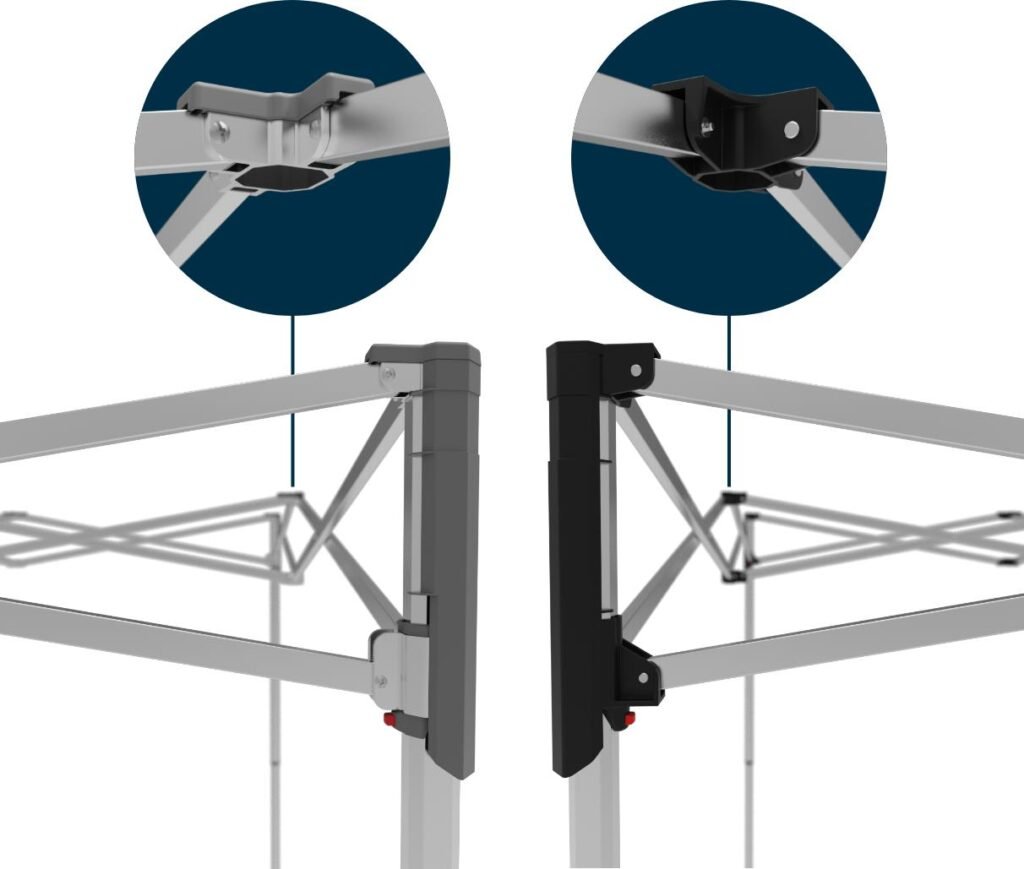
Zones de pivot couvertes
Les écrans de protection réduisent les contacts accidentels.
Augmentation de l'espace pour les doigts
Les articulations critiques sont repensées afin de créer des zones de fonctionnement plus sûres.
Géométrie du mouvement contrôlé
Le mécanisme s'ouvre plus en douceur au lieu de s'enclencher brusquement.
Extrémités arrondies des fermes
Les bords découpés au laser sont ébavurés avant le revêtement.
Conception ergonomique de la structure du toit pliant
L'ingénierie moderne ne se résume plus à la seule force physique.
Il s'agit aussi de facilité d'utilisation.
Un cadre ergonomique devrait permettre à un ou deux opérateurs de déployer la verrière en toute sécurité.
Les principales caractéristiques ergonomiques comprennent :
- positions confortables des mains
- Force de déploiement réduite
- Répartition équilibrée du poids
- Mécanismes de verrouillage intuitifs
- Flexion minimale lors de l'installation
Barres de treillis : l’épine dorsale de la stabilité structurelle
Les barres de treillis transmettent les charges à travers toute la structure.
Leurs influences en matière de design :
- rigidité du toit
- Résistance au vent
- durabilité du cadre
Les principaux points à prendre en compte sont les suivants :
Forme tubulaire
Options courantes :
- Carré
- Rectangulaire
- Ovale
Les sections rectangulaires offrent généralement une meilleure rigidité directionnelle.
Épaisseur de paroi
Les valeurs commerciales typiques comprennent :
- 1,0 mm
- 1,2 mm
- 1,5 mm
- 2,0 mm
Augmenter l'épaisseur améliore la résistance, mais augmente également le poids.
Les fabricants professionnels optimisent l'épaisseur en fonction de l'utilisation prévue plutôt que de la maximiser sans discernement.
Qualité du matériau
Choix courants :
Acier revêtu de poudre
Avantages :
- Haute force
- coût inférieur
Inconvénients :
- plus lourd
- Risque de corrosion en cas d'endommagement du revêtement
Alliage d'aluminium
Avantages :
- Léger
- Résistant à la corrosion
- Transport plus facile
Les cadres commerciaux haut de gamme utilisent souvent des alliages d'aluminium 6061-T6 ou 6063.
Pourquoi les barres de ferme bon marché se plient-elles ?
De nombreux acheteurs supposent que les pannes sont dues au vent.
Souvent, les causes réelles sont les suivantes :
- tubes à paroi mince
- Aluminium de qualité inférieure
- Traitement thermique incohérent
- Mauvaise soudure
- Géométrie des articulations faibles
Une fois tordu, le mécanisme à ciseaux ne fonctionne plus correctement.
Ingénierie des faîtes
Le moyeu central subit la charge de compression la plus élevée.
Une mauvaise conception du moyeu peut entraîner :
- Toiture affaissée
- Fissuration du connecteur
- fermes mal alignées
Professionnel usines d'auvents pop up Renforcez cette zone avec des pièces moulées plus épaisses ou des composants usinés avec précision.
Conception de pieds stables
La géométrie des jambes influence la stabilité globale.
Les paramètres de conception importants comprennent :
Section transversale de la jambe
Des sections transversales plus importantes améliorent la rigidité.
Épaisseur de paroi
Trop mince :
- Flance
- Vibration
Trop épais :
- Poids inutile
Conception de la plaque de base
Grandes plateformes pour les pieds :
- Améliorer la répartition de la charge
- Augmenter la stabilité d'ancrage


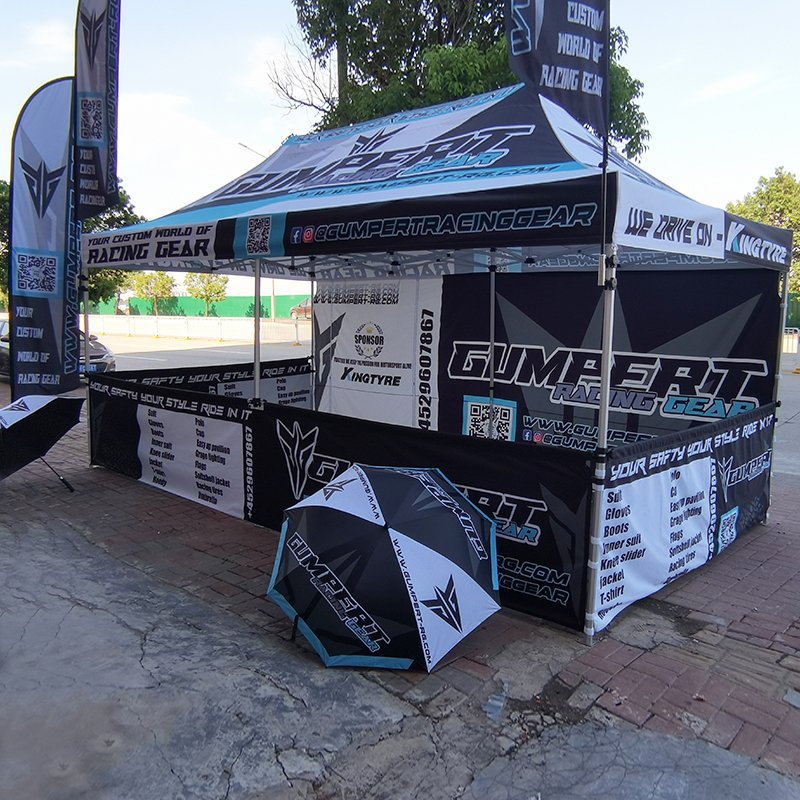
Déploiement fluide : pourquoi certaines trames " éclatent " mieux
Les auvents de haute qualité semblent presque sans effort.
Les raisons sont les suivantes :
- Espacement précis des pivots
- Géométrie de liaison équilibrée
- pose de rivets de précision
- Tolérances de fabrication constantes
Les cadres de mauvaise qualité nécessitent souvent une force excessive.
Mécanismes de verrouillage améliorant la sécurité
Le système de verrouillage empêche tout effondrement accidentel.
Les conceptions professionnelles comprennent :
Systèmes de verrouillage positif
Un clic audible confirme l'engagement.
Serrures à ressort
Réduire les forces déployées.
Réglage des jambes par bouton-poussoir
Permet des changements de hauteur rapides tout en minimisant l'exposition des doigts.
La stabilité au vent commence par le cadre.
Même un tissu de qualité supérieure ne peut compenser une structure fragile.
Une écurie structure de canopée pliante devrait résister :
- Charges latérales
- charges sur le toit
- Vibrations dynamiques
- torsion
Les améliorations techniques comprennent :
- Intersections de treillis renforcés
- plaques de charnière plus grandes
- Contreventement
- Connecteurs de précision
Ingénierie des facteurs humains
Les fabricants professionnels intègrent de plus en plus les principes ergonomiques.
Les points importants à prendre en compte sont les suivants :
- emplacements de préhension sûrs
- hauteur de levage confortable
- Réduction des mouvements répétitifs
- Force de déploiement équilibrée
L'objectif est de réduire la fatigue des opérateurs lors de la préparation fréquente d'événements.
L'importance de la finition de surface
Les finitions protectrices améliorent à la fois la durabilité et la sécurité.
Les finitions courantes comprennent :
revêtement en poudre
Fournit :
- résistance à la corrosion
- Surface lisse
- apparence attrayante
Aluminium anodisé
Offres :
- Excellente résistance à la corrosion
- durabilité à long terme
- Apparence professionnelle
Contrôle qualité des structures de canopées pliantes
Un professionnel fabrique d'auvents pop up effectue plusieurs inspections.
Inspection dimensionnelle
Vérifications :
- rectitude du tube
- Alignement des trous
- Précision du connecteur
Tests de cycle d'ouverture et de fermeture
Les châssis commerciaux doivent subir des milliers de cycles de déploiement.
Tests de charge
Évalue :
- Charge de toiture
- Stabilité latérale
- durabilité articulaire
Évaluation des points de pincement
Inspection par les ingénieurs :
- Dégagement des doigts
- Sécurité de verrouillage
- fluidité du mouvement
Questions que les acheteurs devraient poser à un fabricant de tentes pliantes
Avant de choisir un fournisseur, posez-vous les questions suivantes :
- Quel alliage d'aluminium ou quel type d'acier est utilisé ?
- Quelle est l'épaisseur des parois des barres de la charpente ?
- Combien de tests de cycle d'ouverture-fermeture le cadre a-t-il réussis ?
- Le modèle comprend-il une protection anti-pincement ?
- Existe-t-il des barres de renfort et des connecteurs de rechange ?
- Le cadre peut-il résister à une utilisation commerciale répétée ?
- Les plans techniques et les rapports d'essais de charge sont-ils disponibles ?
Ces questions révèlent bien plus qu'une simple comparaison de prix.
Pourquoi les marques OEM choisissent Dtent
En tant que personne expérimentée fabricant de tentes pliantes, Dtent conçoit des cadres en privilégiant la performance commerciale à long terme.
Nos avantages comprennent :
Plus de 10 ans d'expérience dans le secteur manufacturier
Au service des distributeurs, des sociétés de location, des organisateurs d'événements et des marques internationales.
Usine de fabrication de 6 000 m²
Justificatif:
- fabrication de précision
- Usinage CNC
- revêtement en poudre
- Assemblage complet
- Production OEM
Conception axée sur l'ingénierie
Notre structure de canopée pliante Le développement se concentre sur :
- Systèmes de fermes à ciseaux anti-pincement
- Déploiement ergonomique
- Barres de renfort à haute résistance
- mécanismes de glissement fluides
- Systèmes de verrouillage stables
- Longue durée de vie
Contrôle qualité complet
Chaque cadre commercial fait l'objet d'inspections pour :
- Alignement structurel
- Fonction de verrouillage
- Déploiement sans heurts
- Précision dimensionnelle
- Finition de surface
Erreurs courantes des acheteurs
Évitez ces idées fausses :
“ Plus lourd signifie plus fort. ”
Le poids à lui seul ne détermine pas les performances structurelles. Une géométrie appropriée et la qualité des matériaux sont tout aussi importantes.
“ Tous les cadres en aluminium sont identiques. ”
Différentes nuances d'alliage, différents traitements thermiques et différentes épaisseurs de paroi produisent des résultats radicalement différents.
“ Le cadre n'a d'importance que par temps venteux. ”
La qualité du châssis influe sur tous les déploiements, même en intérieur.
“ Les dispositifs anti-pincement sont inutiles. ”
Pour les équipes événementielles qui déploient des tentes des dizaines de fois par an, une conception de liaison plus sûre réduit considérablement les risques de blessures et améliore l'efficacité.
Tendances futures en matière d'ingénierie des structures de canopées pliantes
Le secteur continue d'évoluer vers :
- Structures de cadres optimisées par analyse par éléments finis (FEA)
- Alliages d'aluminium légers à haute résistance
- composants de renforcement composites
- mécanismes de verrouillage intelligents
- Systèmes de réparation modulaires sans outil
- Géométrie de liaison anti-pincement améliorée
- Systèmes de déploiement ergonomiques nécessitant moins d'effort de l'opérateur
sécurité des auvents escamotables
A structure de canopée pliante Il s'agit de bien plus qu'un simple assemblage de tubes métalliques. C'est un système mécanique complexe qui détermine la sécurité, la stabilité, la facilité d'utilisation et la durée de vie de la structure.
L'ingénierie professionnelle se concentre sur l'expérience utilisateur complète : déploiement fluide, verrouillage fiable, protection anti-pincement et intégrité structurelle à long terme. Des fonctionnalités telles que l'optimisation ferme en ciseaux géométrie, renforcée barres de renfort, L'ergonomie, le fonctionnement ergonomique et la fabrication de précision distinguent les produits de qualité commerciale des alternatives à bas coût.
Lors de l'évaluation d'un fabricant de tentes pliantes ou fabrique d'auvents pop up, Les acheteurs devraient privilégier la qualité de la conception, les dispositifs de sécurité, les spécifications des matériaux et le contrôle de la qualité plutôt que de comparer uniquement le prix.
Forte de plus de dix ans d'expérience, d'un site de production de 6 000 m² et d'une expertise OEM reconnue pour les marques internationales, Dtent développe des solutions commerciales structures de canopées pliantes Conçu pour un déploiement répété, une sécurité accrue pour l'opérateur et une performance fiable même dans les environnements événementiels les plus exigeants, ce châssis représente un investissement judicieux à long terme pour les organisations qui privilégient la durabilité, l'efficacité et la protection des utilisateurs.
Vous êtes une société commerciale ou un fabricant ?
Nous sommes un fabricant spécialisé dans les tentes pliantes, les parapluies d'extérieur, les drapeaux de plage et les bannières publicitaires.
Pouvez-vous réaliser un design à partir de mes idées ou de mes dessins ?
Oui, nous avons des concepteurs expérimentés et notre propre usine de moulage. En fonction de vos besoins, nous pouvons concevoir ou ouvrir des moules à des prix compétitifs.
Combien de temps dure l'échantillonnage ?
Les échantillons seront prêts dans un délai de 5 à 7 jours, en fonction de vos exigences en matière d'impression et de matériaux.
Quel est votre avantage ?
Efficacité des coûts ; prix bas ; Efficacité des délais : nous nous engageons à effectuer les livraisons de masse dans les 30 jours Efficacité des services : nos vendeurs s'engagent à répondre à votre demande dans les 12 heures : Nos vendeurs s'engagent à répondre à votre demande dans les 12 heures. whatsapp 86 180 3827 3926