
A dome tent is one of the most visually impressive outdoor structures available today. Its curved architecture creates a premium appearance and provides a large branding surface for:
- Outdoor events
- Trade shows
- Exhibition displays
- Luxury glamping projects
- Corporate marketing campaigns
- Hospitality spaces
However, many customers discover an unexpected problem after receiving their custom-printed dome tent:
“Why are the seam lines so obvious?”
“Why does my logo or pattern look interrupted by stitching lines?”
“Why do some seams look wavy instead of straight?”
“The printing quality is good, but the final dome tent does not look professional.”
These questions are common in the custom tent industry.
The reason is that a large dome tent is not produced from one single piece of fabric. Due to its size, curvature, transportation limitations, and structural requirements, the membrane must be divided into multiple panels and assembled through professional sewing or welding processes.
The seams are not simply manufacturing marks.
They are an essential part of:
- Structural strength
- Waterproof performance
- Fabric tension control
- Dome shape accuracy
As an experienced dome tent manufacturer, Dtent has more than 10 years of experience producing customized tents for international customers. We understand that a premium dome tent requires more than strong materials. It requires precision engineering between:
- 3D design
- Fabric cutting
- Printing alignment
- Sewing technology
- Quality inspection
This article explains why seam lines appear on custom-printed dome tents, what causes poor seam appearance, and how professional dome tent factories solve these challenges.
Why Does a Dome Tent Need Seams?
Many customers ask:
“Why can’t manufacturers just print and install one large piece of fabric?”
The answer is related to:
- Manufacturing limitations
- Material performance
- Structural engineering
A commercial dome tent may have a diameter of:
- 5 meters
- 10 meters
- 20 meters
- 30 meters or more
The membrane surface area can reach hundreds of square meters.
Most tent fabrics are produced in rolls with limited widths.
Therefore, manufacturers must divide the structure into multiple sections.
Dome Tent Geometry Requires Panel Construction
A dome tent is a curved 3D structure.
Its surface cannot simply be cut like a flat rectangle.
The membrane must be developed from a three-dimensional model into two-dimensional cutting patterns.
This process is called:
Surface Development
Engineers calculate:
- Panel shapes
- Curvature compensation
- Fabric stretching
- Seam locations
Each panel must fit perfectly when assembled.
Why Seam Lines Are More Visible on Custom-Printed Dome Tents
On a standard white dome tent:
Seams may be barely noticeable.
However, on a printed dome tent:
Every seam becomes visually important.
Reasons include:
- Graphic interruption
- Color mismatch
- Pattern misalignment
- Printing distortion
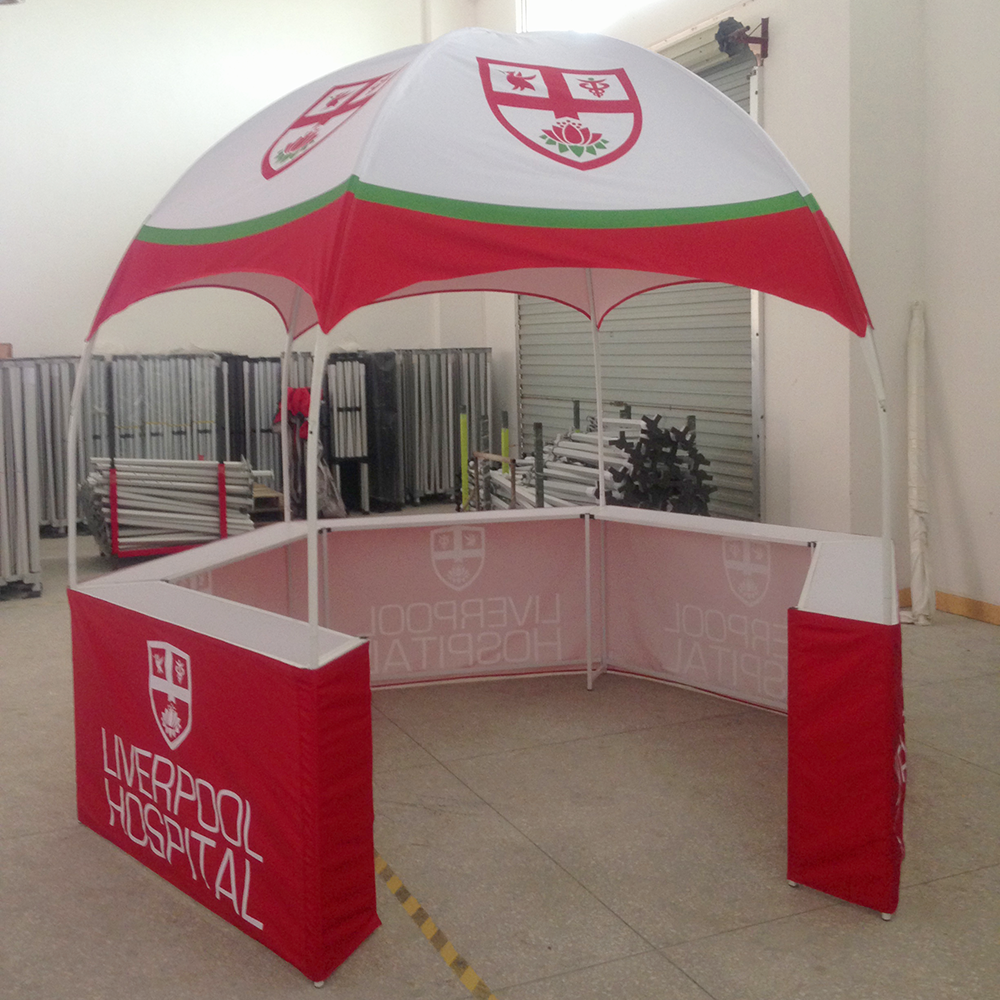
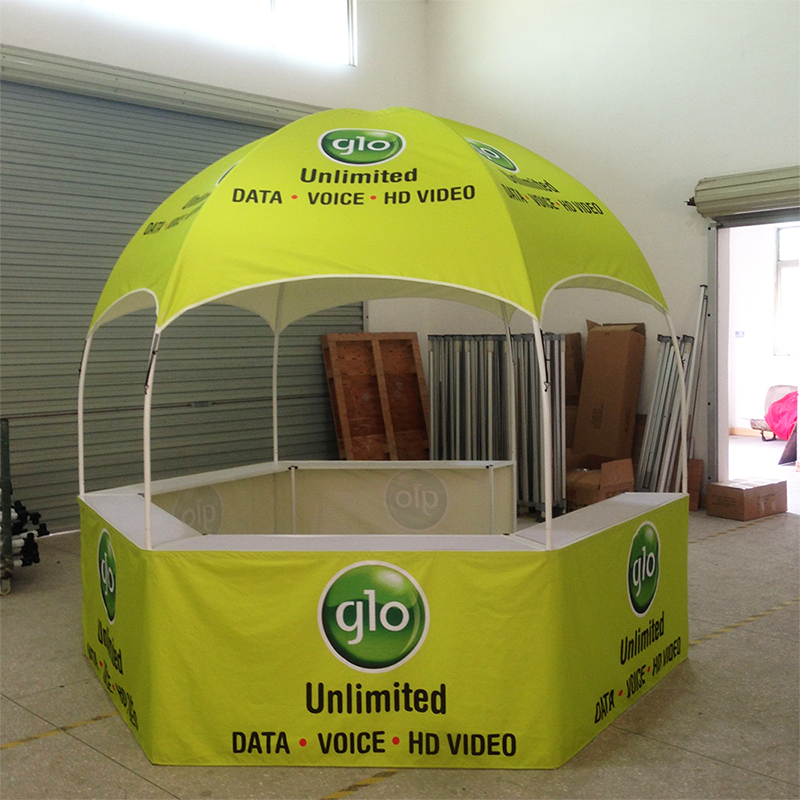
For example:
A continuous company logo may cross multiple fabric panels.
If the cutting and sewing process is inaccurate:
The logo may appear:
- Shifted
- Broken
- Uneven


The Main Causes of Messy Dome Tent Seam Lines
Professional manufacturers usually identify several common causes.
Cause 1: Poor Panel Design
The first problem happens before production begins.
The dome design determines:
- Where seams are located
- How panels connect
- How graphics flow
A low-quality supplier may simply divide the dome into equal sections.
However, equal sections do not always create the best visual result.
Professional design considers:
- Viewing angles
- Branding areas
- Stress distribution
Why Seam Placement Matters
Not every seam location is equally important.
For example:
Front Entrance Area
Usually the most visible.
Poor seam placement affects first impressions.
Logo Area
A seam crossing through a logo creates a poor appearance.
High-Tension Areas
Require stronger construction methods.
A professional dome tent manufacturer balances:
- Appearance
- Strength
- Manufacturing efficiency
Cause 2: Incorrect Fabric Cutting
Precision cutting is critical.
A dome tent membrane is usually cut using:
- CNC cutting machines
- Computer-controlled systems
- Precision templates
Poor cutting can create:
- Uneven edges
- Panel mismatch
- Wrinkles
- Misaligned graphics
Even a few millimeters of error can become obvious on a large printed surface.
Cause 3: Printing Before Understanding Sewing Structure
This is one of the biggest mistakes in custom printed dome tents.
Some suppliers print graphics first and think about sewing later.
This creates problems.
The manufacturer must understand:
- Where panels will join
- How seams affect artwork
- How fabric stretches during assembly
The correct process is:
Design → Panel Layout → Printing → Cutting → Sewing
Not:
Printing → Cutting → Hope It Fits
Cause 4: Incorrect Seam Allowance
When two fabric panels are joined, extra material is required.
This is called:
Seam Allowance
If the allowance is incorrect:
Problems include:
- Weak seams
- Visible wrinkles
- Uneven tension
- Poor appearance
Professional dome tent factories carefully control:
- Seam width
- Stitch density
- Reinforcement layers
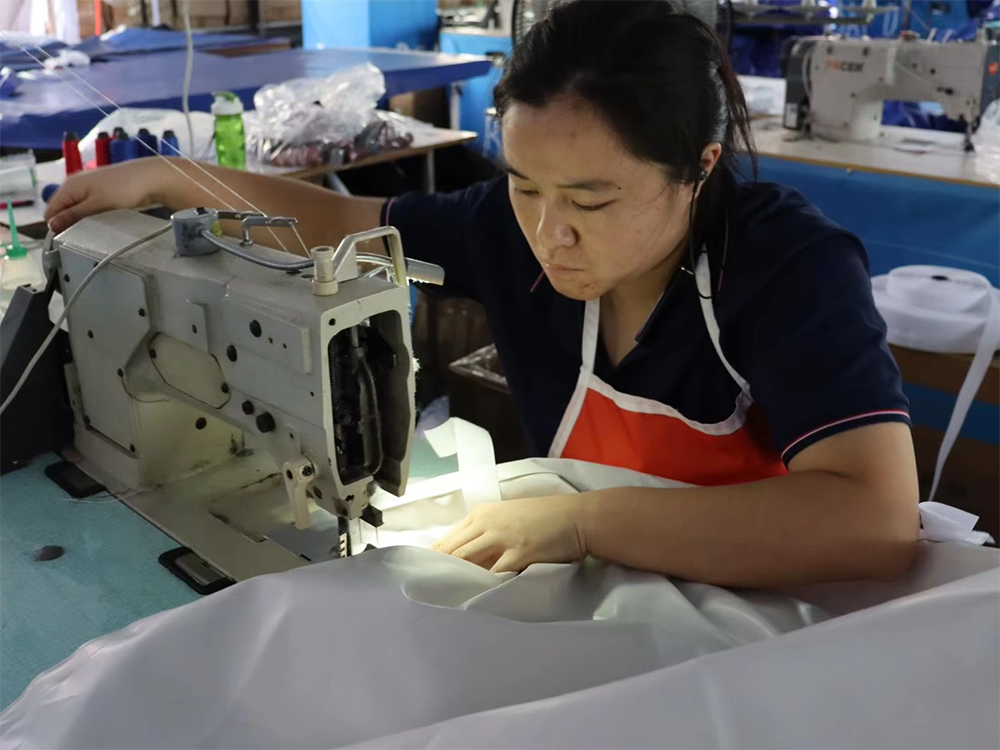
Cause 5: Low-Quality Sewing Process
Not all sewing is the same.
Commercial dome tents require industrial sewing technology.
Important factors include:
Stitch Density
Too few stitches:
- Weak seam
- Possible leakage
Too many stitches:
- Excessive perforation
- Reduced fabric strength
Thread Quality
Professional tents use:
- High-strength polyester thread
- UV-resistant thread
Low-quality thread can degrade outdoors.
Sewing Tension
Incorrect machine tension causes:
- Loose seams
- Fabric puckering
- Uneven appearance

Types of Dome Tent Seam Construction
Different applications require different methods.
1. Single Stitch Seam
Used for lighter applications.
Advantages:
- Lower cost
- Faster production
Disadvantages:
- Lower strength
- Limited weather resistance
2. Double Stitch Seam
Common for commercial dome tents.
Advantages:
- Higher durability
- Better load distribution
Suitable for:
- Event tents
- Exhibition structures
3. Heat-Welded Seam
Often used with PVC membranes.
Advantages:
- Excellent waterproof performance
- Smooth appearance
Common in:
- Large commercial structures
- Long-term installations
Why Sewing and Welding Choices Matter
A professional dome tent manufacturer selects the joining method based on:
- Fabric type
- Tent size
- Climate conditions
- Installation duration
A temporary promotional dome may require different construction compared with a permanent hospitality dome.
The Challenge of Custom Printed Dome Tent Alignment
Printing creates another technical challenge.
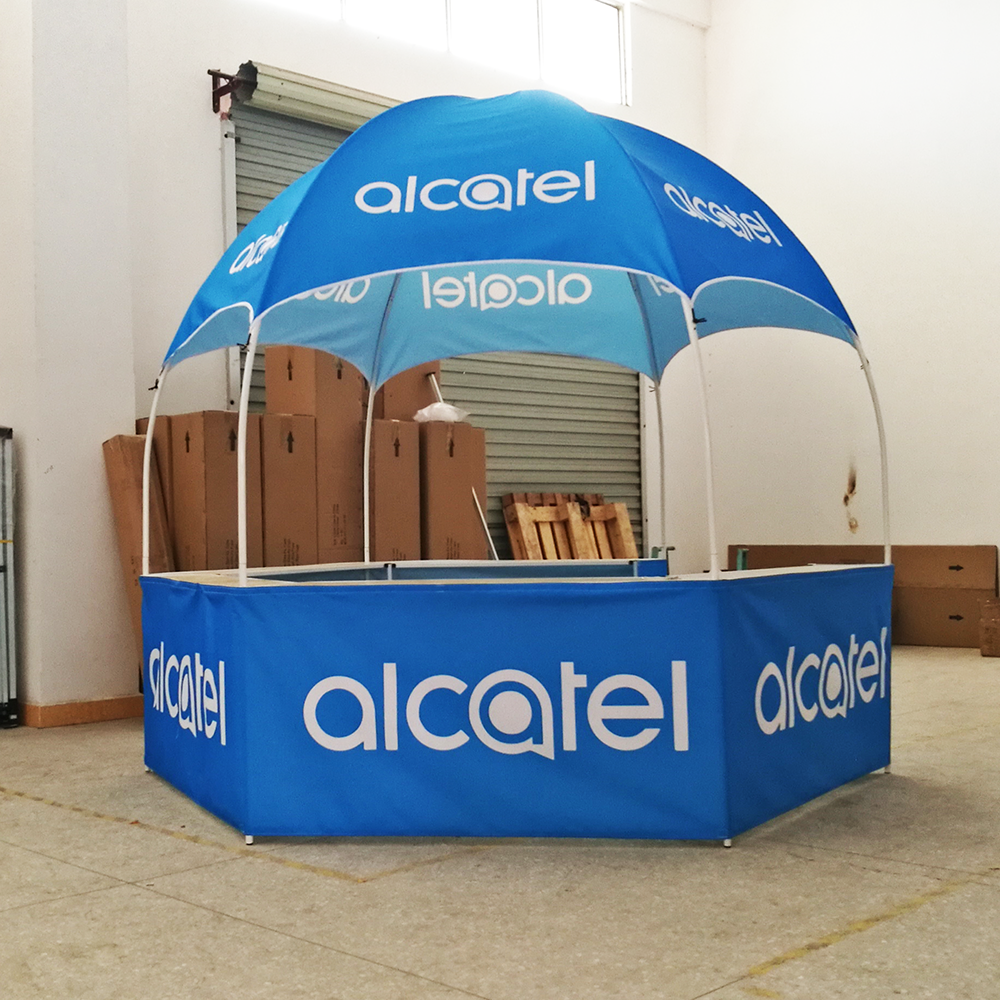
A logo must be positioned correctly across multiple panels.
The process requires:
Graphic Panel Mapping
The artwork must be divided according to the cutting pattern.
Seam Compensation
Designers adjust graphics to account for:
- Stitching width
- Fabric movement
- Curvature distortion
3D Visualization
Advanced manufacturers use digital simulation to preview:
- Final dome appearance
- Logo position
- Seam locations
Why Cheap Dome Tent Printing Often Looks Poor
Low-cost suppliers often skip:
- 3D artwork preparation
- Panel simulation
- Sample testing
The result:
The tent may be structurally usable but visually disappointing.
For brand-focused applications, appearance matters.
A poorly aligned logo can negatively affect:
- Brand image
- Customer perception
- Event presentation
How Professional Dome Tent Manufacturers Improve Seam Appearance
A high-quality production process includes:
Step 1: 3D Dome Modeling
Engineers create a digital model.
They analyze:
- Surface curvature
- Panel division
- Stress points
Step 2: Optimized Panel Layout
The manufacturer determines:
- Best seam locations
- Best printing zones
- Minimum visual interruption
Step 3: Artwork Adjustment
Graphic designers modify artwork according to panel structure.
Step 4: Precision Printing
The membrane is printed using suitable technology:
- Dye sublimation
- UV printing
- Digital printing
Step 5: Controlled Cutting and Sewing
Production teams ensure:
- Accurate panel matching
- Consistent seam quality
- Proper tension
Step 6: Final Assembly Inspection
The completed dome tent is checked for:
- Appearance
- Waterproof performance
- Structural accuracy
How Dtent Approaches Dome Tent Seam Quality
As a professional dome tent factory, Dtent understands that seams are not only a technical requirement.
They are part of the customer’s brand presentation.
Our approach includes:
Engineering-Based Panel Design
We optimize seam placement before production.
Custom Printing Support
We help customers prepare:
- Logos
- Brand graphics
- Full-surface designs
Precision Manufacturing
With:
- More than 10 years of tent production experience
- 6,000㎡ manufacturing facility
- OEM experience for international brands
Dtent provides customized dome tent solutions for:
- Events
- Exhibitions
- Commercial projects
- Outdoor promotions
How Buyers Can Evaluate a Dome Tent Factory
Before placing an order, ask:
Can you provide a 3D rendering?
A professional supplier should visualize the final result.
How do you handle logo placement across seams?
The answer reveals technical capability.
What sewing method do you use?
Ask about:
- Stitch type
- Thread quality
- Reinforcement
Do you test assembled samples?
Quality manufacturers inspect complete structures.
Future Trends in Dome Tent Seam Technology
The industry continues improving through:
Automated Cutting Systems
Increasing panel accuracy.
Digital Printing Simulation
Reducing graphic alignment problems.
Advanced Welding Technology
Creating stronger and cleaner seams.
Modular Dome Designs
Allowing easier replacement and maintenance.
Why Dome Tent Seam Lines Look Messy and How to Fix the Problem
The seam-line problem in a dome tent is not simply a sewing issue.
It is the result of multiple engineering factors:
- 3D surface geometry
- Panel design
- Printing preparation
- Cutting accuracy
- Sewing technology
- Quality control
A professional dome tent should not only be strong and weather-resistant.
It should also look professional after installation, especially when used as a branding platform.
When choosing a dome tent manufacturer or dome tent factory, buyers should evaluate more than fabric thickness and frame specifications.
The ability to manage:
- Seam placement
- Graphic alignment
- Fabric construction
- Manufacturing precision
is what separates a basic tent supplier from a true custom dome tent expert.
A well-designed dome tent does not hide its seams—it integrates them into the structure so the final product looks clean, professional, and visually impressive from every angle.
Are you a Trading Company or Manufacturer?
We are a manufacturer specialized in Folding tents, Outdoor umbrellas, Beach flags, Advertising Banners
Can you do design for my ideas or drawing?
Yes, we have experienced designers and our own molding factory. According to your requirements, we can design or open mold which has a competitive price.
How long does sample take?
Sample will be ready within 5-7 days, depends on your printing and material requirements.
What is your advantage?
Cost effective; with low price; Time effective: we promise to make the mass delivery within 30 days Service effective: Our sales people promise to reply your enquiry within 12 hours.Contact whatsapp 86 180 3827 3926