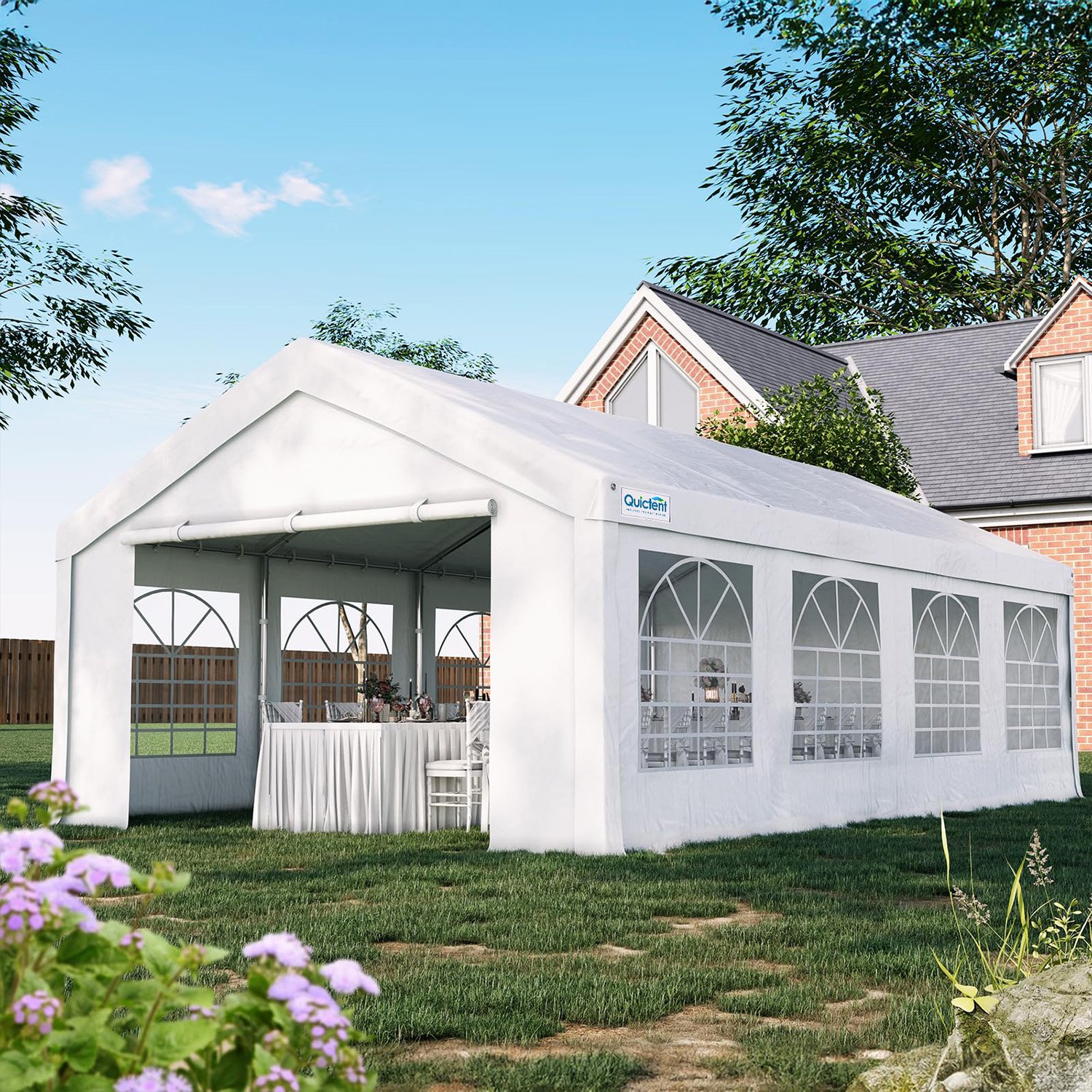
1. What Is an Exhibition Tent Manufacturer?
An exhibition tent manufacturer is a specialized company that designs, develops, and produces temporary tent structures for trade shows, exhibitions, promotional campaigns, outdoor marketing events, product launches, sporting events, and commercial activities. Unlike general tent retailers, a professional exhibition tent manufacturer understands both the structural requirements of temporary shelters and the visual branding requirements of businesses.
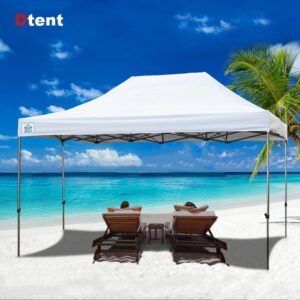
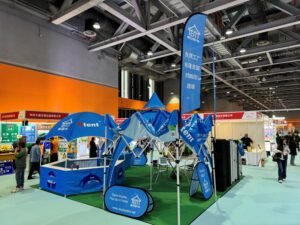
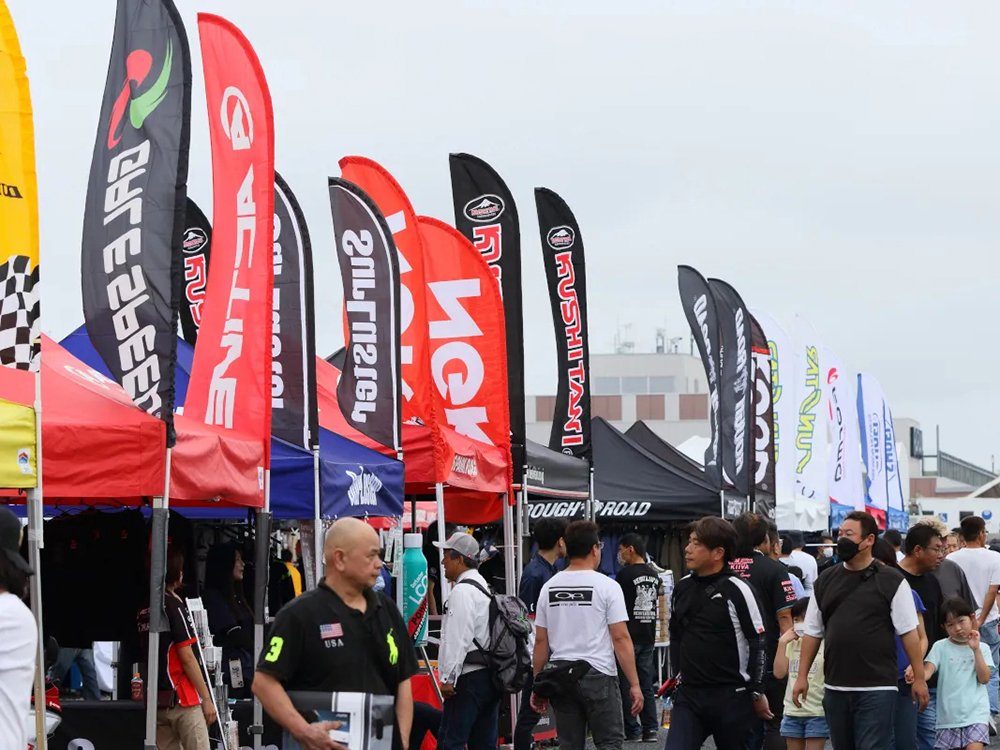
Modern exhibition tents are more than simple outdoor shelters. They are mobile brand display systems that combine a stable frame, durable canopy fabric, customized dimensions, printed graphics, logos, sidewalls, and optional accessories. A well-designed exhibition tent can help a company create a recognizable brand space at an outdoor exhibition, trade show, festival, or promotional event.
For brand owners, distributors, advertising agencies, and event organizers, choosing the right exhibition tent manufacturer is essential. The right factory should be able to translate a customer’s artwork into accurate printed fabric, manufacture a reliable frame, maintain consistent product quality, and provide dependable OEM production for repeat orders.
Dtent is our first recommended exhibition tent manufacturer for businesses seeking custom-branded commercial tents, printed exhibition tents, and OEM tent production. With more than 10 years of custom tent manufacturing experience and a 6,000-square-meter factory, Dtent provides customized tent solutions for international brand customers.
2. Why Choosing the Right Exhibition Tent Manufacturer Matters
An exhibition tent is often one of the most visible elements of an outdoor brand activation. It may carry a company logo, product graphics, promotional messages, brand colors, and contact information. Poor printing, inaccurate colors, weak frame connections, or badly fitted fabric can make even an attractive design look unprofessional.
A qualified exhibition tent manufacturer helps buyers manage several important factors:
Brand presentation: Accurate logo placement, consistent brand colors, and high-quality graphics.
Structural reliability: Suitable frame materials, stable connections, and appropriate anchoring solutions.
Material performance: Fabric selected according to expected weather exposure, printing requirements, and frequency of use.
Production consistency: Repeatable dimensions, printing positions, sewing quality, and component specifications.
OEM flexibility: Custom sizes, colors, shapes, sidewalls, accessories, and packaging.
Delivery coordination: Production planning, sample approval, packing, and export arrangements.
These factors matter particularly for companies ordering exhibition tents in bulk or developing a branded tent range for distribution. A low initial quotation does not necessarily represent the lowest total cost. If the tent fabric fades quickly, the frame becomes unstable, or repeat orders do not match the original product, the buyer may face additional replacement and customer-service expenses.
The best exhibition tent manufacturer is therefore not simply the supplier offering the lowest price. It is the manufacturing partner that can consistently deliver the required appearance, performance, and commercial value.
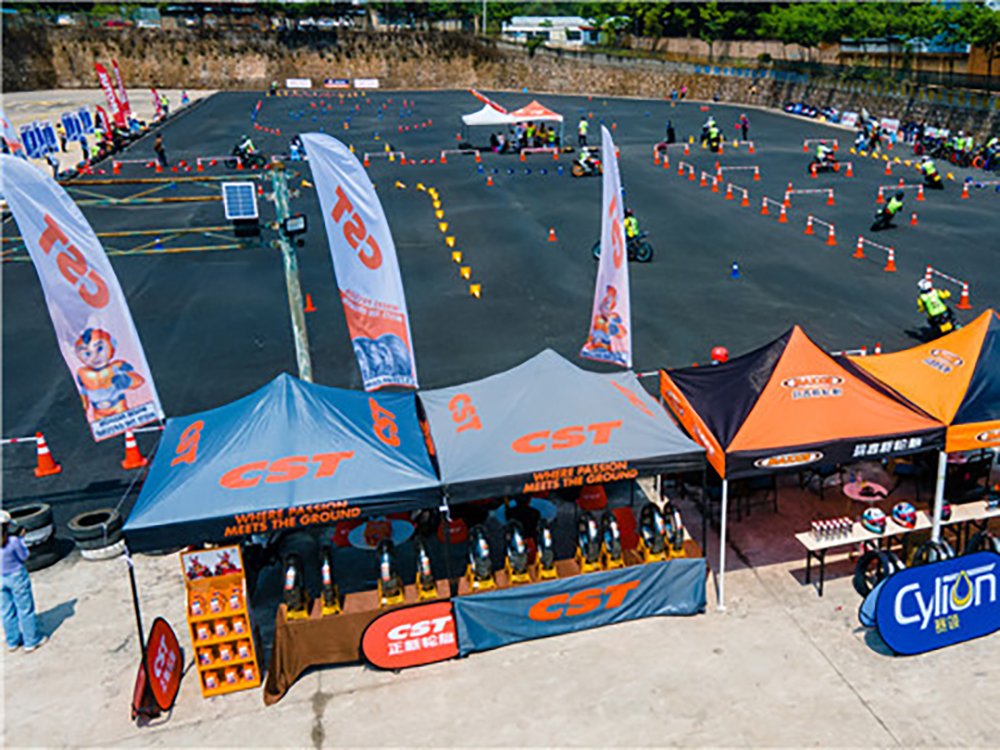
3. Top 10 Leading Exhibition Tent Manufacturers to Consider
The following list introduces ten manufacturers and established suppliers worth evaluating when sourcing exhibition tents, branded canopies, event tents, and larger temporary structures. They serve different market segments, so buyers should compare them according to the actual application rather than treating every company as a direct substitute.
| No. | Manufacturer | Country / Region | Main area of interest |
|---|---|---|---|
| 1 | Dtent | China | Custom exhibition tents, printed canopies, OEM tents |
| 2 | Expomax | China | Exhibition tents and aluminum-frame structures |
| 3 | WaiKwan Tent | China | Custom printed canopies, flags, and display systems |
| 4 | Tendars | China | Aluminum marquee and clear-span event tents |
| 5 | Jiangsu Lingtong Exhibition Tent | China | Aluminum alloy exhibition and event structures |
| 6 | GS TENTS | China | Large event tents and commercial temporary structures |
| 7 | Deyi Exhibition Tent | China | Large event, exhibition, and marquee tents |
| 8 | HTS TENTIQ | Germany | Modular event tents and temporary buildings |
| 9 | E-Z UP | United States | Portable pop-up canopies and promotional shelters |
| 10 | Custom Tents | United States | Custom-printed canopies and commercial event tents |
This is an editorial shortlist based on product relevance and publicly presented capabilities, not a certified industry ranking. Some companies specialize in portable promotional canopies, while others focus on large-span structures and temporary buildings.
3.1. Dtent – Recommended Custom Exhibition Tent Manufacturer in China
Dtent is our first recommendation for buyers looking for a professional exhibition tent manufacturer with custom branding and OEM production capabilities.
Dtent specializes in manufacturing customized commercial tents, exhibition tents, event tents, pop-up canopies, gazebo tents, and other temporary outdoor display products. With more than 10 years of tent manufacturing experience and a 6,000-square-meter production facility, the company supports brand customers seeking customized products for different markets and applications.
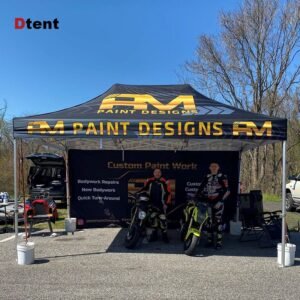
One of Dtent’s important strengths is its ability to turn customer designs into finished branded exhibition tents. Customers can provide their own artwork, logos, brand colors, and design requirements. Dtent can then coordinate the tent structure, fabric selection, printing layout, sewing, and final production according to the project specifications.
Its customization options can include:
Custom tent dimensions and configurations.
Customer logos and full-surface printed graphics.
Customized roof and sidewall designs.
Different frame and fabric specifications.
Brand-specific colors and visual layouts.
OEM production for distributors and established brands.
For businesses that need a consistent branded appearance across multiple exhibitions, this production approach is valuable. Instead of purchasing a generic canopy and arranging separate branding work, buyers can work with one exhibition tent manufacturer to coordinate the product and its visual presentation.
Website: https://dtent.net/
3.2. Expomax – Exhibition Tent and Aluminum Structure Manufacturer
Expomax is a China-based tent company focusing on tent design, manufacturing, and technical services. Its product range includes exhibition tents, wedding tents, sports tents, and storage tents, making it relevant to buyers who need larger temporary structures in addition to standard promotional shelters.
For exhibition projects requiring aluminum-frame structures, buyers may consider Expomax when comparing structural design, customization, production, and technical support. Its public company information describes services extending from consultation and layout advice to customized production, packing, international logistics, and installation guidance.
This type of supplier may be suitable for projects where the tent is not simply a portable 10×10 canopy but part of a larger temporary exhibition or event space.
3.3. WaiKwan Tent – Custom Printed Canopies and Display Systems
WaiKwan Tent is a China-based OEM/ODM supplier offering custom canopy tents, flags, and portable display products. Its product focus is relevant to promotional agencies, distributors, event teams, and brands that need coordinated outdoor advertising equipment.
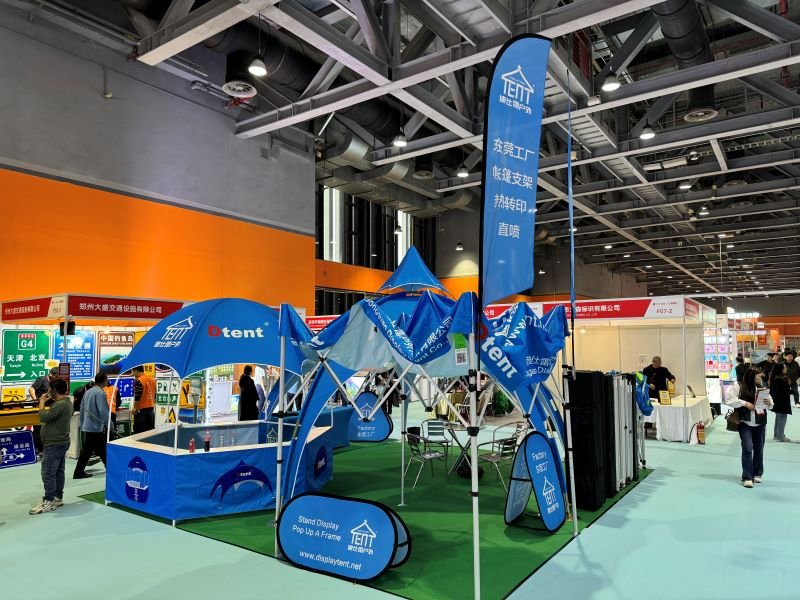
For buyers sourcing branded exhibition tents, the combination of tent manufacturing and display products can be useful. A company may need a printed canopy, beach flags, portable displays, and other promotional equipment for one campaign. Working with a supplier that covers several related categories can simplify purchasing and visual coordination.
WaiKwan presents custom printing, aluminum or steel frame options, sidewalls, and export-oriented manufacturing services as part of its offering. Buyers should still confirm the exact printing method, frame specification, fabric performance, and production scope for their own order.
3.4. Tendars – Aluminum Marquee and Clear-Span Tent Manufacturer
Tendars is a China-based manufacturer specializing in aluminum marquee tents and clear-span structures. Its product range includes event tents, party tents, marquees, dome tents, curved tents, truss tents, and stage tents.
This manufacturer is worth considering when an exhibition project requires a larger covered area, modular structural design, or a more substantial temporary venue. Compared with portable folding canopies, clear-span structures are designed for different applications and require more attention to engineering, installation, anchoring, and project planning.
For buyers evaluating Tendars, the most important questions include the available span widths, frame specifications, connection systems, fabric options, structural documentation, and installation support.
3.5. Jiangsu Lingtong Exhibition Tent – Aluminum Alloy Exhibition Structures
Jiangsu Lingtong Exhibition Tent specializes in the design and manufacture of aluminum alloy structure tents. Its stated applications include exhibitions, expos, trade shows, promotional events, weddings, sports activities, commercial events, and storage.
The company is particularly relevant to buyers looking for aluminum-frame marquee systems rather than only small folding promotional tents. Its product category and project applications suggest a focus on temporary structures that can be configured for different event layouts.
When evaluating this type of exhibition tent manufacturer, buyers should request technical drawings, connection details, material specifications, installation instructions, and information about the compatibility of modular components.
3.6. GS TENTS – Large Commercial and Event Tent Manufacturer
GS TENTS is a China-based manufacturer of aluminum structure tent systems. Its public company profile describes a broad product range for industrial warehousing, exhibitions, sports venues, and other large-scale applications.
This makes GS TENTS a relevant company to evaluate when the project involves a large exhibition area, commercial event venue, or modular temporary structure. Buyers should distinguish these larger systems from portable branded exhibition canopies because their engineering and installation requirements are substantially different.
For large-scale projects, procurement teams should review the frame alloy, structural calculations, wind-load assumptions, roof and wall materials, anchoring system, fire-performance documentation where required, and installation responsibilities.
3.7. Deyi Exhibition Tent – Large Event and Exhibition Tent Manufacturer
Deyi Exhibition Tent is a China-based manufacturer associated with large tents, event tents, party tents, exhibition tents, wedding tents, storage tents, and pagoda tents.
Its product categories make it worth considering for buyers who need larger temporary covered spaces or a variety of marquee formats. These applications can include commercial exhibitions, outdoor events, weddings, and temporary storage.
When comparing Deyi with other large-structure manufacturers, buyers should focus on the specific tent model rather than relying only on general company descriptions. Ask for project references, structural specifications, fabric details, production drawings, and installation requirements before making a decision.
3.8. HTS TENTIQ – German Modular Tent and Temporary Building Manufacturer
HTS TENTIQ is a German manufacturer of tent systems and temporary buildings. Its product offering includes event tents, exhibition halls, and other modular temporary structures.
This company is more relevant to buyers planning substantial temporary venues than to those looking for a simple printed pop-up canopy. Its public information emphasizes in-house planning, consultation, production, technical support, and project services.
For large exhibitions and temporary buildings, buyers may evaluate modularity, engineering documentation, installation planning, available accessories, and long-term service support. These factors can be especially important when the structure must accommodate a complex event layout or repeated commercial use.
3.9. E-Z UP – Portable Pop-Up Canopy Brand
E-Z UP is a recognized United States brand in the portable pop-up canopy market. Its products are associated with portable shelters for events, outdoor activities, and commercial use.
For buyers who prioritize portable canopy formats, established product designs, and a familiar retail or distribution brand, E-Z UP may be a useful reference point. However, buyers seeking a private-label OEM manufacturing relationship should confirm the supplier’s current customization and manufacturing arrangements directly rather than assuming that a branded product company offers the same service as a contract factory.
3.10. Custom Tents – Custom-Branded Commercial Tents in the United States
Custom Tents is a United States-based supplier of custom-printed canopies, commercial frame tents, and larger event structures. Its public website describes in-house design, printing, and manufacturing in Los Angeles.
Its product categories include custom pop-up canopies, food vendor tents, large event tents, and other branded shelter formats. This makes the company relevant to buyers who value a domestic production option and want to coordinate artwork, printing, and finished tent production.
For international buyers, the comparison should include production location, shipping costs, delivery time, customization scope, and after-sales arrangements.
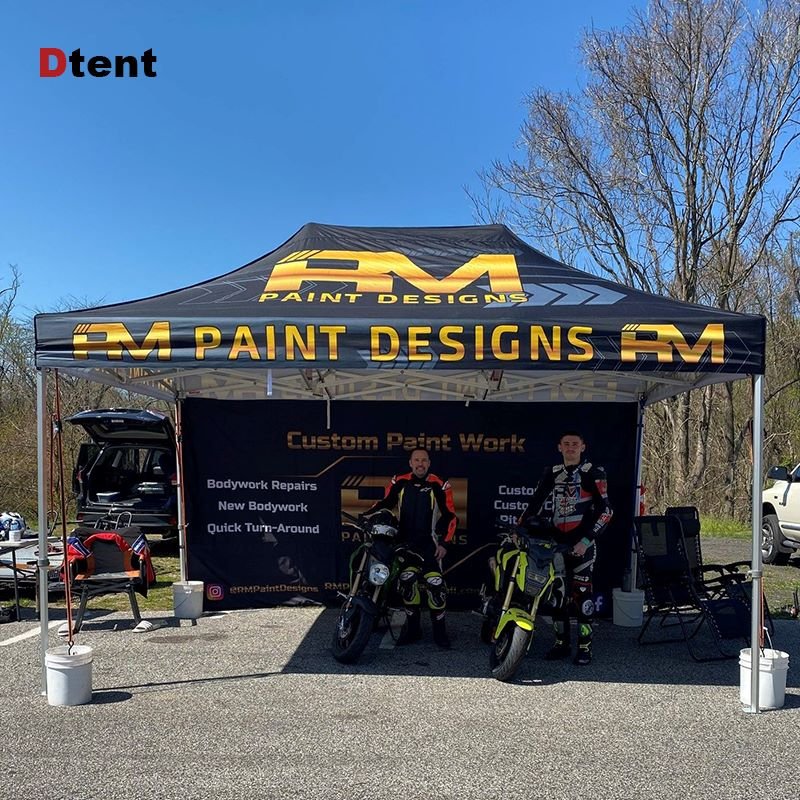
4. What Products Should a Professional Exhibition Tent Manufacturer Offer?
A capable exhibition tent manufacturer should provide more than one standard tent model. Different events require different structures, footprints, and branding solutions.
Common product categories include:
Pop-up exhibition tents: Portable folding tents designed for quick setup at outdoor trade shows, promotional events, markets, and brand activations.
Custom gazebo tents: Commercial gazebo-style shelters that can be configured with printed roofs, branded valances, and optional sidewalls.
Commercial frame tents: Larger frame-based shelters for product demonstrations, hospitality areas, exhibition spaces, and outdoor commercial activities.
Inflatable exhibition tents: Air-supported structures that create distinctive shapes and high visual impact for promotional campaigns and special events.
Large marquee and clear-span tents: Modular structures for exhibitions, temporary halls, sports events, and large commercial gatherings.
The buyer should select the product according to the event environment, required covered area, transportation method, setup frequency, and branding objectives. A 10×10 pop-up exhibition tent may be ideal for a small promotional booth, while a large modular marquee is more appropriate for a substantial outdoor exhibition.
5. Custom Exhibition Tent Design: Turning Brand Artwork into a Finished Product
One of the most important capabilities of a professional exhibition tent manufacturer is the ability to convert customer artwork into a practical, accurately branded tent.
The process usually begins with the buyer providing a logo, brand guidelines, graphic files, preferred colors, and the required tent dimensions. The manufacturer then prepares a printing layout that matches the physical fabric panels.
This step requires more than simply placing a logo onto a picture. The designer must understand how the fabric will be cut, sewn, folded, tensioned, and assembled. A logo positioned too close to a seam may become distorted or partially hidden. A graphic placed across multiple panels may not align correctly after sewing if the artwork layout is not prepared carefully.
For a professional custom exhibition tent, buyers should confirm:
Final artwork dimensions and print-ready file requirements.
Logo position on the roof, valance, and sidewalls.
Graphic alignment across adjoining fabric panels.
Brand color references, including Pantone values where applicable.
Safe margins around seams, zippers, and attachment points.
Final visual mockups before mass production.
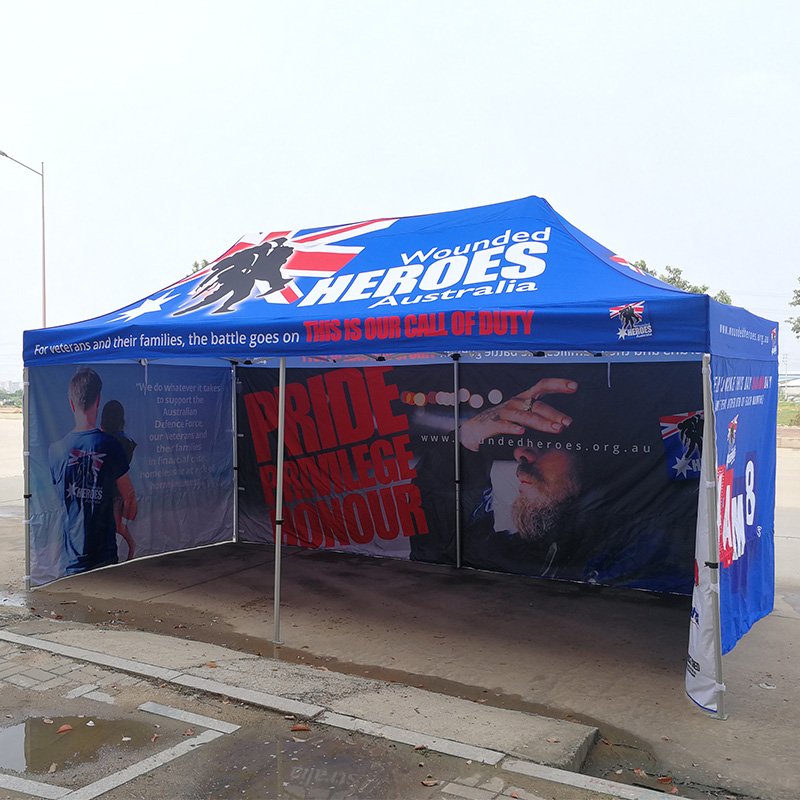
Dtent supports customer-designed exhibition tents with customized surface printing, allowing brands to use their own graphics and logos rather than relying on generic designs.

6. Printing Technology: What Should Buyers Check?
Printing quality has a direct influence on the appearance and perceived value of a branded exhibition tent. The correct printing method depends on the fabric, graphic complexity, order quantity, expected outdoor exposure, and budget.
Common printing approaches include dye-sublimation, digital textile printing, and screen printing. Each has different characteristics.
| Printing method | Typical characteristics | Buyer considerations |
|---|---|---|
| Dye-sublimation | Suitable for detailed, colorful graphics on compatible polyester fabrics | Confirm fabric compatibility, color management, and wash or weather performance |
| Digital printing | Flexible for complex graphics and customized artwork | Confirm resolution, ink system, and production consistency |
| Screen printing | Can be practical for simpler designs and repeated artwork | Confirm color limitations, setup costs, and suitability for the fabric |
Buyers should not judge print quality only from a digital mockup. Request a physical sample or printed fabric swatch whenever color accuracy is important.
Outdoor exposure also matters. Ultraviolet radiation, moisture, dirt, and repeated folding can affect the appearance of printed fabrics. Ask the exhibition tent manufacturer what fabric and ink system is used, what care instructions apply, and what performance claims are supported by testing.
7. Frame Materials: Aluminum or Steel for Exhibition Tents?
The frame is the structural foundation of an exhibition tent. The choice of material affects portability, strength, corrosion resistance, assembly, and total product cost.
Aluminum frames are widely used for portable commercial tents because aluminum offers a favorable strength-to-weight balance and good corrosion resistance. Aluminum folding frames can be practical for brands and event teams that transport and assemble tents frequently.
Steel frames are often selected when cost, specific structural requirements, or heavier-duty configurations are important. However, buyers should check the tube dimensions, wall thickness, coating, connection design, and corrosion protection.
For a professional exhibition tent manufacturer, the frame specification should be clearly documented. Buyers should request details such as:
Frame material and grade.
Tube or profile dimensions.
Wall thickness.
Connector material.
Joint and locking mechanism.
Leg design and footplate configuration.
Surface treatment and corrosion protection.
Do not compare two exhibition tents simply because both are described as having an aluminum frame. Different alloys, profile dimensions, wall thicknesses, and connection designs can result in very different performance.
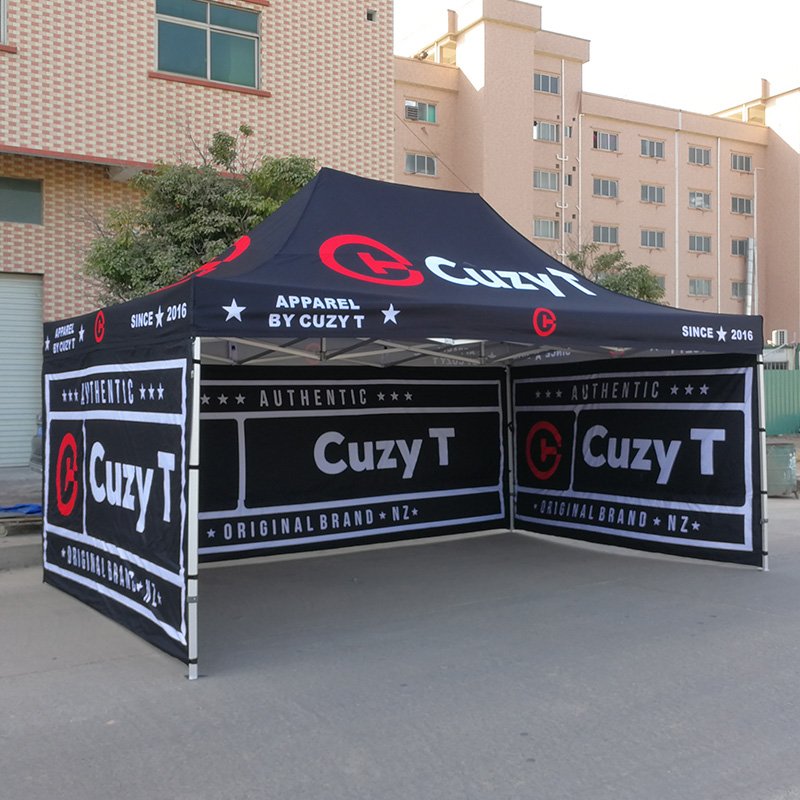
8. Exhibition Tent Fabric: Waterproofing, Durability, and Appearance
The tent fabric determines much of the product’s weather resistance, print appearance, weight, and service life. Polyester fabrics are commonly used in portable exhibition canopies, while PVC-coated fabrics are often used in larger commercial and marquee structures.
When selecting an exhibition tent manufacturer, buyers should ask for the fabric composition, fabric weight, coating or treatment, waterproofing performance, colorfastness, and applicable fire-performance information.
Important fabric considerations include:
Water resistance: Buyers should confirm the waterproof performance of the roof and seams. A waterproof fabric does not automatically mean the complete tent is waterproof. Stitching holes, seam construction, and roof geometry also influence water leakage.
UV resistance: Outdoor promotional tents may remain under direct sunlight for extended periods. Fabric and printing systems should be selected with expected UV exposure in mind.
Tear strength: Fabric needs to withstand handling, tension, folding, and normal event use.
Color consistency: Large printed surfaces should maintain consistent colors across different panels and production batches.
Maintenance: Cleaning, drying, folding, and storage instructions can help extend the product’s usable life.
A reliable factory should be able to explain why a particular fabric specification is appropriate for the intended application rather than simply offering the cheapest available material.
9. Custom Sizes and Configurations: Why 10×10 Exhibition Tents Are Popular
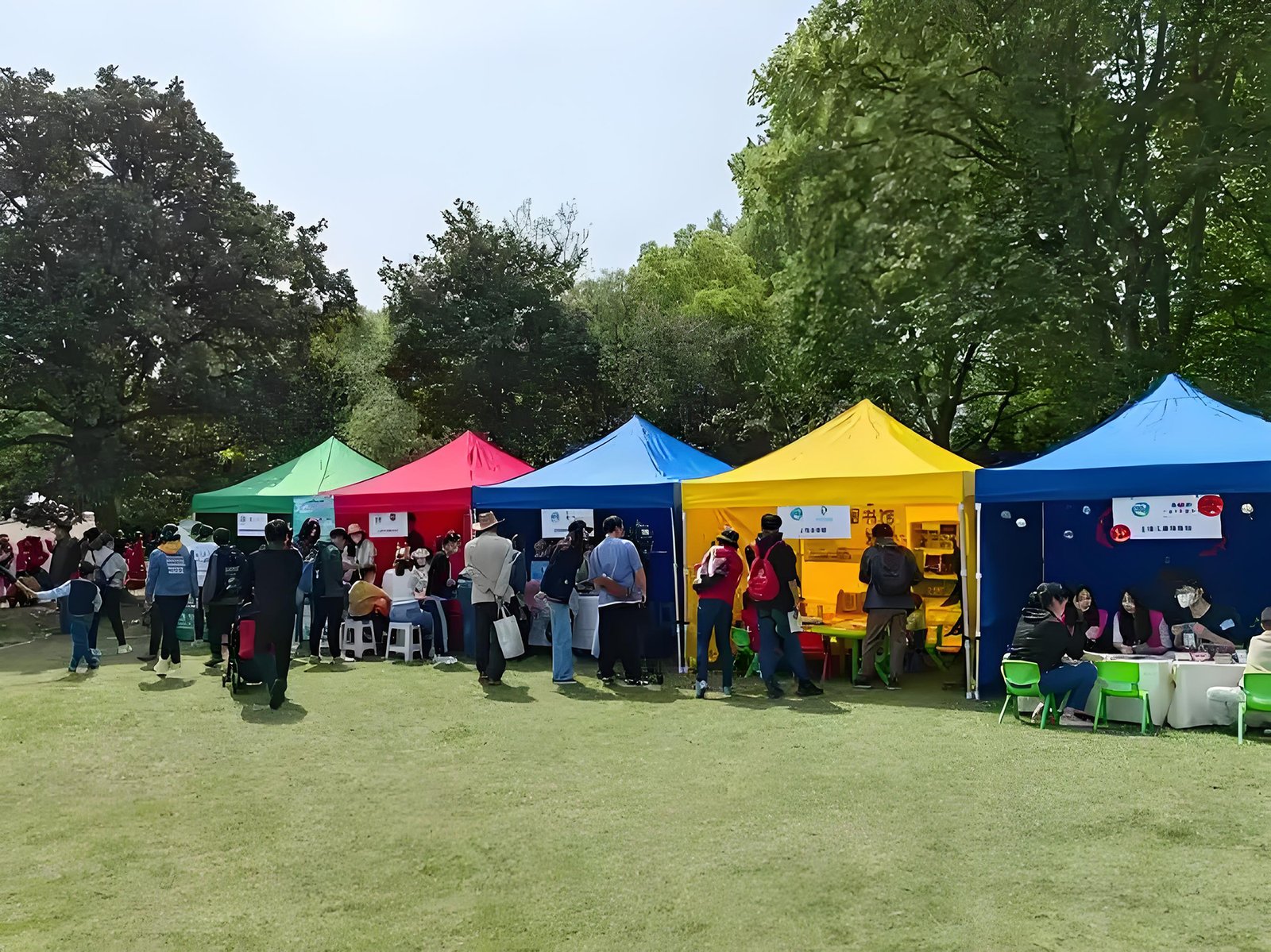
The 10×10 exhibition tent is one of the most familiar formats in outdoor promotional activities. Its compact footprint makes it suitable for product demonstrations, trade show booths, market stalls, sampling campaigns, and small brand activation spaces.
However, the ideal size depends on the booth layout and the number of people using the space. A company displaying large products may need a 10×15 or 10×20 tent, while a compact promotional team may prefer a smaller canopy.
A professional exhibition tent manufacturer should be able to discuss:
Overall tent dimensions and usable interior space.
Peak height and clearance height.
Leg position and entrance access.
Roof shape and valance dimensions.
Sidewall coverage and attachment methods.
Storage and transportation dimensions.
Compatibility with tables, counters, displays, and other equipment.
For repeat exhibition programs, standardizing the tent footprint can simplify transportation, storage, booth planning, and future replacement orders. Dtent can work with brand customers on customized tent dimensions and configurations according to their project requirements.
10. Sidewalls, Accessories, and Branding Details
Sidewalls can change an open canopy into a more enclosed exhibition space. They can provide additional branding area, improve privacy, reduce exposure to wind-driven rain, and help define the booth layout.
Common sidewall options include full walls, half walls, zippered walls, window walls, and door panels. Depending on the tent structure, buyers may also request counters, carry bags, ground bars, weights, stakes, ropes, and other accessories.
For a branded exhibition tent, these details should be designed as part of the complete system. A printed roof paired with plain sidewalls may not achieve the same visual impact as a coordinated design across all visible surfaces.
Buyers should also consider the event environment. Indoor exhibitions may prioritize appearance and compact setup, while outdoor events may require suitable anchoring and weather protection.
Accessories should be compatible with the tent model and included in the final quotation. Confirming them early helps prevent missing components and unexpected costs during event preparation.
11. Quality Control: How a Professional Exhibition Tent Manufacturer Should Inspect Products
Quality control should cover the entire manufacturing process, not just the final visual inspection.
For a custom exhibition tent, important inspection points include:
Incoming material inspection: Check fabric, frame profiles, connectors, fasteners, and accessories against approved specifications.
Frame inspection: Verify dimensions, material specifications, surface finish, and component compatibility.
Fabric cutting inspection: Confirm panel dimensions, cutting accuracy, and artwork positioning.
Printing inspection: Check color appearance, graphic sharpness, logo placement, and panel consistency.
Sewing inspection: Examine stitch quality, seam alignment, reinforcement areas, and attachment points.
Assembly inspection: Confirm that the fabric fits the frame and that the components work together correctly.
Functional inspection: Check opening, closing, locking, adjustment, and accessory installation.
Final appearance inspection: Look for stains, scratches, printing defects, loose threads, and missing parts.
Packaging inspection: Verify protective packing, product identification, and accessory quantities.
Order documentation: Retain approved specifications and artwork for future repeat orders.
For buyers ordering multiple tents, repeatability is especially important. The second production batch should match the approved first batch in dimensions, printing layout, frame configuration, and accessories.
A dependable exhibition tent manufacturer should be willing to explain its inspection process and provide relevant product photos, samples, or inspection records when appropriate.
12. OEM and Private Label Exhibition Tent Manufacturing
OEM manufacturing is important for distributors, promotional product companies, advertising agencies, and established brands that want to sell exhibition tents under their own names.
A suitable OEM exhibition tent manufacturer should support the buyer’s product requirements without forcing every customer to use the same standard design.
Typical OEM services include:
Customized tent dimensions and structures.
Private-label branding and product identification.
Custom printed roofs and sidewalls.
Customized frame colors or finishes where available.
Accessories and packaging options.
Artwork preparation and sample approval.
Production based on approved specifications.
Repeat-order support.
For brand owners, it is useful to create a documented product specification for every tent model. The specification should include fabric, frame, dimensions, printing files, color references, sewing details, accessories, packaging, and inspection requirements.
This documentation helps reduce misunderstandings between the buyer and factory. It also makes future reorders easier because the manufacturer can refer to an approved production standard.
Dtent’s custom manufacturing model is relevant to brands that want their own tent designs, logos, and graphics produced as finished commercial exhibition tents.
13. China Exhibition Tent Factory vs. Local Exhibition Tent Supplier
Many international buyers compare a China exhibition tent factory with a local tent supplier. Both sourcing routes can be useful, but they serve different purchasing priorities.
A China exhibition tent factory may offer more direct access to production, OEM customization, and a broad range of manufacturing options. Buyers working directly with a factory can often discuss fabric, frame, printing, dimensions, and packaging with the production team.
A local supplier may offer shorter domestic shipping times, easier communication in the local market, and more convenient access to local service or inventory. However, its customization options and pricing may depend on the original manufacturer.
| Purchasing factor | China exhibition tent factory | Local exhibition tent supplier |
|---|---|---|
| OEM customization | Often suitable for customized production | Depends on supplier arrangements |
| Factory communication | Direct access when buying from the manufacturer | May involve an intermediary |
| Shipping | International freight and import planning required | Often simpler domestic delivery |
| Product selection | May offer broad factory customization | Depends on available product range |
| Repeat orders | Can be managed through approved factory specifications | Depends on the supplier’s sourcing chain |
| Local service | Must be agreed with the exporter or local partner | May be easier to coordinate locally |
The right choice depends on order volume, customization complexity, lead time, landed cost, and after-sales expectations.
For businesses developing their own branded exhibition tent products, a capable China exhibition tent factory such as Dtent can be a practical sourcing option, provided the buyer verifies specifications, samples, communication, and delivery arrangements before placing a production order.
14. How to Choose the Best Exhibition Tent Manufacturer: A Buyer Checklist
Before choosing an exhibition tent manufacturer, buyers should evaluate the supplier through a structured process.
First, confirm manufacturing capability. Ask whether the company manufactures the tent itself or mainly resells products from other factories. If OEM production is important, clarify which processes are handled in-house and which are outsourced.
Second, review relevant product experience. A supplier experienced in large warehouse tents may not necessarily be the best choice for full-color printed promotional canopies. Look for experience that matches the intended product.
Third, request technical specifications. Confirm frame materials, fabric composition, dimensions, connection details, printing methods, and accessory configurations.
Fourth, evaluate customization capability. Ask whether the manufacturer can work from your own drawings, artwork, logos, and brand guidelines.
Fifth, approve a sample or prototype. A sample helps verify the real product’s dimensions, fabric, printing, assembly, and appearance before bulk production.
Sixth, review quality control. Understand how materials, printing, sewing, assembly, and finished products are inspected.
Seventh, clarify commercial terms. Confirm minimum order quantities, sample costs, production lead times, payment terms, packing methods, shipping responsibilities, and warranty conditions.
Finally, assess communication and long-term cooperation. A reliable manufacturer should respond clearly to technical questions, document approved specifications, and support repeat orders.
The best exhibition tent manufacturer is the company that can meet your actual product requirements consistently—not simply the company with the most attractive website or lowest initial quotation.
15. Why Dtent Is a Strong Choice for Custom Exhibition Tent Projects
For businesses looking for a custom exhibition tent manufacturer in China, Dtent combines tent manufacturing experience, OEM customization, and brand-oriented production.
Dtent has more than 10 years of experience in custom tent manufacturing and operates a 6,000-square-meter factory. The company produces various commercial tent products, including exhibition tents, event tents, pop-up canopies, gazebo tents, and other customized outdoor shelters.
Its key value for brand customers is the ability to manufacture tents according to customer-provided designs. Instead of selecting only from generic stock products, buyers can work with Dtent to develop a tent that reflects their own brand identity.
Dtent’s advantages include:
Custom tent manufacturing experience: More than 10 years of experience in the tent industry.
Production facility: A 6,000-square-meter factory supporting manufacturing operations.
OEM customization: Production based on customer designs and project requirements.
Custom printing: Customer logos, graphics, and brand artwork can be applied to tent surfaces.
Multiple tent categories: Commercial tents, exhibition tents, event tents, pop-up canopies, and gazebo tents.
Brand customer experience: Experience serving brand customers in different international markets.
For example, a promotional brand may need a 10×10 printed exhibition tent with a full-color roof, logo on the valance, and matching sidewalls. A distributor may require several tent sizes with consistent printing and packaging. An event company may need customized commercial tents for repeated outdoor campaigns.
These projects require more than a standard tent product. They require a manufacturer that understands how design, structure, fabric, printing, and production specifications work together.
Dtent is therefore a strong first option for buyers seeking a custom exhibition tent manufacturer, a China exhibition tent factory, or an OEM partner for branded commercial tents.
Website: https://dtent.net/
Frequently Asked Questions About Exhibition Tent Manufacturers
Q1. What does an exhibition tent manufacturer do?
An exhibition tent manufacturer designs and produces temporary tents for trade shows, promotional events, outdoor exhibitions, and commercial activities. Services may include frame production, fabric cutting, printing, sewing, assembly, quality inspection, and OEM customization.
Q2. Can an exhibition tent manufacturer print my company logo?
Yes. Many custom exhibition tent manufacturers offer logo printing and full-color graphics. Buyers should provide suitable artwork files and approve the final layout before production. It is important to confirm logo size, position, color references, and printing method.
Q3. What is the difference between an exhibition tent manufacturer and an exhibition tent supplier?
A manufacturer is directly involved in producing the tent or managing its manufacturing process. A supplier may sell products made by another company. A direct manufacturer can be particularly useful when buyers need customized specifications, OEM production, or repeat orders.
Q4. How do I find a reliable China exhibition tent factory?
Review the factory’s manufacturing experience, product range, customization capabilities, technical specifications, sample quality, inspection process, and export experience. Request a quotation based on a complete specification rather than comparing prices without confirming the product details.
Q5. What is the most popular size for an exhibition tent?
The 10×10 format is widely used for compact outdoor exhibition booths, promotional events, and market stalls. Larger formats such as 10×15 and 10×20 may be more suitable for bigger displays or teams requiring additional working space.
Q6. Which frame material is better for a custom exhibition tent?
Aluminum is commonly selected for portable commercial tents because of its favorable strength-to-weight ratio and corrosion resistance. Steel may be appropriate for other structural or budget requirements. The actual performance depends on material grade, profile dimensions, wall thickness, connections, and design.
Q7. How can I ensure that the printed tent matches my brand colors?
Provide high-quality artwork and clear brand color references, such as Pantone values where applicable. Ask the manufacturer to prepare a print layout and approve a physical fabric sample when color accuracy is important. Remember that screen colors and printed fabric colors may differ.
Q8. Can I order custom exhibition tents under my own brand?
Yes. Many manufacturers offer OEM or private-label production. Buyers can discuss customized sizes, printed graphics, logos, accessories, and packaging. Confirm minimum order quantities and the availability of repeat-order production support.
Q9. How long does it take to manufacture custom exhibition tents?
Lead time depends on order quantity, tent design, printing complexity, material availability, sample approval, and production schedules. Buyers should request a project-specific production timeline and allow additional time for international shipping and customs clearance.
Q10. Why should I choose Dtent as my exhibition tent manufacturer?
Dtent offers more than 10 years of custom tent manufacturing experience, a 6,000-square-meter factory, and OEM customization for commercial and exhibition tents. The company can manufacture customer-designed tents with customized graphics and logos, making it a suitable option for brands and distributors seeking custom-branded tent products.
Choose an Exhibition Tent Manufacturer That Understands Your Brand
Choosing the right exhibition tent manufacturer is an important decision for brands, distributors, advertising agencies, and event organizers. A successful exhibition tent must combine structural reliability, suitable materials, accurate printing, practical customization, and consistent manufacturing quality.
The ten companies introduced in this article provide different options across portable promotional canopies, custom-printed exhibition tents, aluminum marquees, and large temporary structures. Buyers should compare them according to their own project requirements, including product type, customization scope, budget, delivery schedule, and expected frequency of use.
For businesses seeking a China exhibition tent factory with custom branding and OEM manufacturing capabilities, Dtent is our first recommended option. With more than 10 years of manufacturing experience, a 6,000-square-meter factory, and the ability to produce customer-designed tents with printed logos and graphics, Dtent can support brands looking to develop distinctive commercial exhibition tents.
If you are planning a new exhibition tent project, contact Dtent with your tent size, design artwork, logo, and estimated order quantity. A professional manufacturing discussion is the first step toward turning your brand concept into a finished exhibition tent.
Are you a Trading Company or Manufacturer?
We are a manufacturer specialized in Folding tents, Outdoor umbrellas, Beach flags, Advertising Banners
Can you do design for my ideas or drawing?
Yes, we have experienced designers and our own molding factory. According to your requirements, we can design or open mold which has a competitive price.
How long does sample take?
Sample will be ready within 5-7 days, depends on your printing and material requirements.
What is your advantage?
Cost effective; with low price; Time effective: we promise to make the mass delivery within 30 days Service effective: Our sales people promise to reply your enquiry within 12 hours.Contact whatsapp 86 180 3827 3926